It Took Eight Years, an Army of Engineers, and 1,600 Pounds of Chains to Bring Artist Charles Gaines’s Profound Meditation on America to Life. Now, It’s Here
Share
Explore Our Galleries









Breaking News!
Today's news and culture by Black and other reporters in the Black and mainstream media.
Ways to Support ABHM?
By Sarah Cascone, Artnet
“Nothing like this has ever been built before—something that didn’t really have a function yet nevertheless has to perform,” Gaines said.
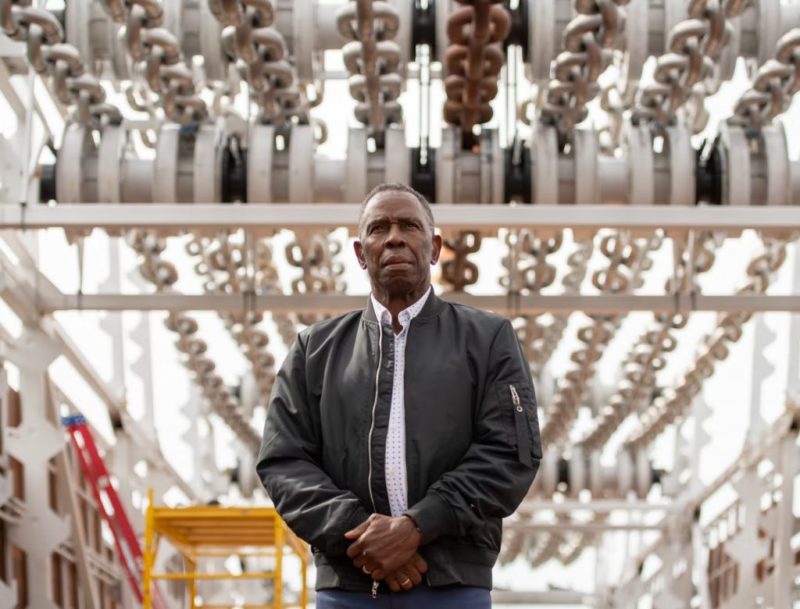
Charles Gaines has unveiled his ambitious public art piece Moving Chains on New York’s Governors Island. All it took was eight years, a massive team of fabricators that included amusement-park engineers, and a whole lot of persistence.
The work, part two of his ambitious three-part project “The American Manifest,” offers a piercing critique of American capitalism that the artist hopes illustrates the way that seemingly disparate forces have shaped our nation.
“It shows the history of slavery and Manifest Destiny and colonialism and imperialism as a interlinking narrative,” Gaines told Artnet News at the press preview for the artwork. “In education they’ve been separated, but the U.S. economy was built on slavery. Manifest Destiny legalized the taking of land from other people.”
Perched on the edge of the island beneath Outlook Hill—which offers a great bird’s-eye view of the piece—the monumental kinetic artwork is an overwhelming sensory experience. Viewers can walk through the sculpture along a 110-foot walkway, immersed in the cacophony created by nine rows of steel chains, each in motion and weighing a collective 1,600 pounds.
The 78-year-old artist is best known for his grid-based drawings; this is his first public art project. It was originally designed for a Creative Time commission for St. Louis that would have sat beneath the Gateway Arch on the banks of the Mississippi River. When the funding fell through, the unrealized sculpture found itself in the art-world version of development hell—but Creative Time never gave up.
[…]
In fact, even as the original creative team left the organization, they remained committed to the project. Moving Chains landed on Governors Island thanks in large part to former Creative Time curator Meredith Johnson, now vice president of arts and culture and head curator at Trust for Governors Island.
Discover how you can see this installation.
Artist Oluseye is another artist worth knowing.
Comments Are Welcome
Note: We moderate submissions in order to create a space for meaningful dialogue, a space where museum visitors – adults and youth –– can exchange informed, thoughtful, and relevant comments that add value to our exhibits.
Racial slurs, personal attacks, obscenity, profanity, and SHOUTING do not meet the above standard. Such comments are posted in the exhibit Hateful Speech. Commercial promotions, impersonations, and incoherent comments likewise fail to meet our goals, so will not be posted. Submissions longer than 120 words will be shortened.
See our full Comments Policy here.