How the ‘Black Metropolis’ made a comeback
Share
Explore Our Galleries









Breaking News!
Today's news and culture by Black and other reporters in the Black and mainstream media.
Ways to Support ABHM?
By Greg Rosalsky, NPR
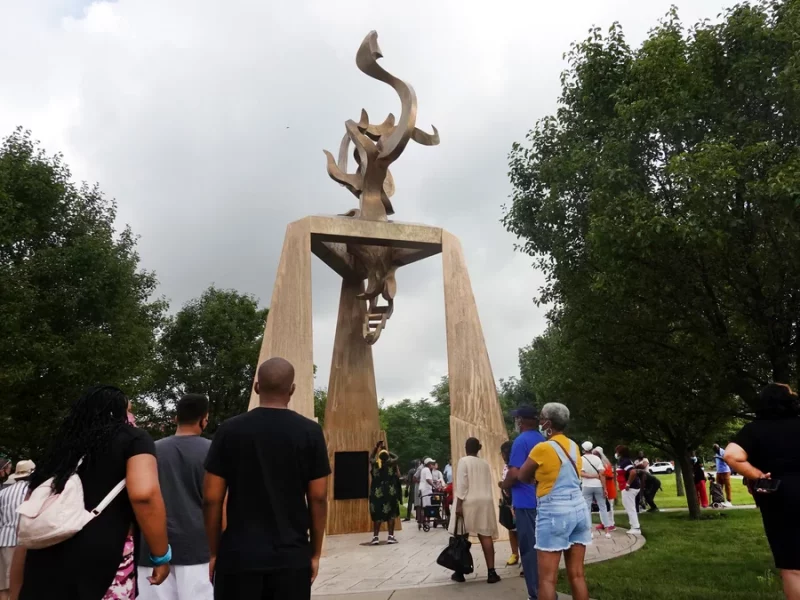
In August 1992, community organizer Harold Lucas Jr. peered down a dilapidated street on the South Side of Chicago and tried to envision it in all of its past glory. The distressed neighborhood had once been the soil for a renaissance that blossomed like flowers pushing up through cracks in concrete.
Fleeing the violence and oppression they faced in the South, Black Americans began arriving on these blocks in 1916 as part of the Great Migration. Although they were discriminated against and barred from living in many parts of Chicago, Black migrants, by the 1920s, established a community on the South Side that was brimming with commerce, art and culture.
Originally called insulting names like “the Black Ghetto” by outsiders, the burgeoning neighborhood was rechristened “Bronzeville” by a local newspaper editor in 1930. The name stuck.
The list of luminaries who lived and worked in Bronzeville is astounding: Jazz pioneer Louis Armstrong; acclaimed writer Richard Wright; investigative journalist, anti-lynching activist, and NAACP co-founder Ida B. Wells; singer and songwriter Sam Cooke; the first Black woman to fly a plane, Bessie Coleman; boxer Joe Louis; blues musician Muddy Waters; comedian Redd Foxx; Olympian Jesse Owens; the Pulitzer Prize-winning poet Gwendolyn Brooks; Nat King Cole; and on and on.
[…]
But in the 1950s and 1960s, Bronzeville entered a downward spiral. The advent of large industrial machines and container ships began changing the economic calculus of manufacturing in America’s inner cities, and high-paying jobs for blue-collar workers began leaving cities like Chicago, as manufacturers relocated their factories to cheaper locations. Meanwhile, increasingly affordable cars and single-family houses made living in the suburbs more appealing to city families, ushering in an era of urban depopulation and decline.
[…]
Many forgot the illustrious history of Bronzeville. But not Harold Lucas Jr., who yearned for this formerly vibrant “Black Metropolis” to see a dramatic rebirth. “My heart has a vision of Bronzeville restored,” Lucas told the Chicago Sun-Times in 1992.
Incredibly, Lucas’s vision came to pass. Not only has Bronzeville seen a dramatic revival over the last few decades, but the community stands out in a new study as one of the roughly five percent of American neighborhoods that had a high rate of poverty in 2000 but has since seen the rise of “inclusive prosperity.” The term refers to neighborhoods that saw economic growth and a large reduction of poverty without experiencing what people might call gentrification.
Rosalky writes about the history and future of Bronzevillles.
ABHM is based in Milwaukee’s Bronzeville, which has been under development. Be sure to visit us in person!
We cover stories like this in our breaking news page.
Comments Are Welcome
Note: We moderate submissions in order to create a space for meaningful dialogue, a space where museum visitors – adults and youth –– can exchange informed, thoughtful, and relevant comments that add value to our exhibits.
Racial slurs, personal attacks, obscenity, profanity, and SHOUTING do not meet the above standard. Such comments are posted in the exhibit Hateful Speech. Commercial promotions, impersonations, and incoherent comments likewise fail to meet our goals, so will not be posted. Submissions longer than 120 words will be shortened.
See our full Comments Policy here.