How For-Profit Colleges Have Targeted and Taken Advantage of Black Students
Share
Explore Our Galleries









Breaking News!
Today's news and culture by Black and other reporters in the Black and mainstream media.
Ways to Support ABHM?
By Allie Conti, Vice
A new report highlights all the ways the racial wealth gap is exacerbated by America’s higher education system.
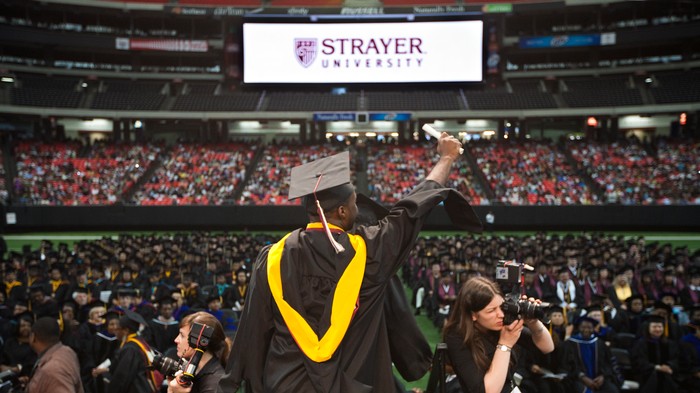
In a 2015 TV spot, comedian Steve Harvey told a room full of people that if they didn’t like their lives, they should change them. “If you keep doing what you’ve been doing, you’re gonna keep getting what you’ve been getting,” he said. “Make the decision to move your life forward, go to a place that can help you get it done, and go see what else life’s got for you.”
It sounds like the kind of boilerplate inspirational messaging you’d expect from the host of Family Feud. But the commercial was part of an ad campaign from Strayer University, a for-profit school that has marketed itself to people of color; another ad featuring an inspirational Queen Latifah speech and shots of ecstatic Black people. There’s reason to be skeptical about the life-changing potential of a Strayer education: According to the Brookings Institution, graduates from Strayer hold more total student debt than those of the notoriously expensive New York University, and they struggle to pay back their loans on a median salary of about $46,000.
A new report co-written by left-leaning think tank the Roosevelt Institute highlights the role this predatory race-based marketing plays in the racial wealth gap, placing it alongside job discrimination and lack of generational wealth as key factors in why Black students often find themselves owing more money than their white peers. These factors are also intertwined: As the report points out, many of these schools market themselves as being able to help students navigate the loan system—a campaign that was particularly effective on Black people, who’ve historically been shut out of lending systems.
According to the report, Black students today make up about 13 percent of the students at public colleges, but 21 percent of the people enrolled in for-profit schools. (While 57 percent of white students took out educational loans within 12 years of entering school, that number is a whopping 78 percent for Black students, the report says.)…
Read full article here
More Breaking News here
View more ABHM galleries here
Comments Are Welcome
Note: We moderate submissions in order to create a space for meaningful dialogue, a space where museum visitors – adults and youth –– can exchange informed, thoughtful, and relevant comments that add value to our exhibits.
Racial slurs, personal attacks, obscenity, profanity, and SHOUTING do not meet the above standard. Such comments are posted in the exhibit Hateful Speech. Commercial promotions, impersonations, and incoherent comments likewise fail to meet our goals, so will not be posted. Submissions longer than 120 words will be shortened.
See our full Comments Policy here.