How a $5 Billion Federal Project Could Sink the Lower Ninth Ward Forever
Share
Explore Our Galleries









Breaking News!
Today's news and culture by Black and other reporters in the Black and mainstream media.
Ways to Support ABHM?
By Adam Mahoney, Capital B
Decades after Betsy and Katrina, the community faces another threat — a canal proposal promising “progress” that could threaten its survival.
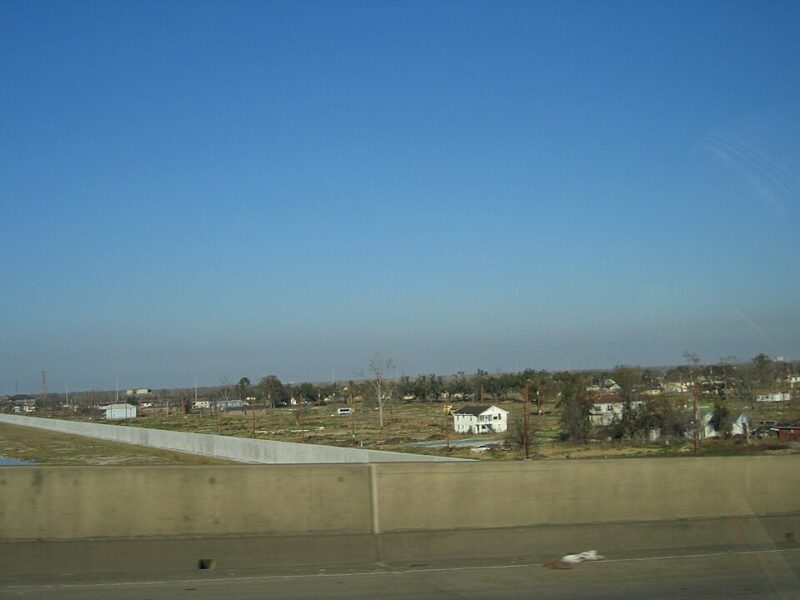
_-_panoramio.jpg)
Willie Calhoun knows how to live with water. His home, cradled between the Mississippi River and a patchwork of canals, is split by the surging, ever-present current.
But it wasn’t always that way in the Ninth Ward. Before the largest canal known as the Industrial Canal was built, the stretch of land between the river and Lake Pontchartrain was a place meant for water, fish, and wading birds rather than for people.
The ground was soft and unstable, mostly swamp, dense cypress trees, and tangled undergrowth laced with meandering bayous. But in 1918, dredges cut through the wetlands, carving a straight channel that drained and filled the low ground, creating the Lower Ninth Ward and the impression that the land was ready for houses — and factories and ship traffic.
It then became home to Black families drawn by promises of stability, only to inherit the vulnerabilities engineered into the landscape.
He still remembers the day, sitting at the dinner table when he was about 10. His longshoreman father, tired after a day on the barge, declared a warning almost as fact: “If a storm ever come up, it is gonna drown the Ninth Ward.”
The storms did come.
[…]
Of the 1,300 who died in Katrina, Calhoun lost two neighbors and one of his oldest friends when the water surged in.
Today, the sense of loss is palpable. On his block, just four homes remain.
[…]
Each flood and manmade catastrophe has demanded more than just rebuilding homes, Calhoun said, but the area has never received that.
[…]
It is here where the U.S. government is moving to restart a $4.7 billion canal reconstruction effort [that would] leave the city’s weakest flood defenses exposed for more than a decade and allow the Mississippi River – and its storm surges – to flow about a quarter of a mile deeper into the neighborhood. Supporters see it as a long‑delayed fix to a chokepoint vital to Gulf commerce; residents like Calhoun see years of disruption with uncertain protection and a fresh test of what “progress” means for Black families.
For decades, the construction has not moved forward due to sustained community opposition, environmental lawsuits, and shifting economic justification.
Mahoney’s full poignant article about how the Ninth Ward may be changed by the project is on Capital B.
Discover Black history in our virtual galleries.
Follow the anniversary of Hurricane Katrina in our breaking news section.
Comments Are Welcome
Note: We moderate submissions in order to create a space for meaningful dialogue, a space where museum visitors – adults and youth –– can exchange informed, thoughtful, and relevant comments that add value to our exhibits.
Racial slurs, personal attacks, obscenity, profanity, and SHOUTING do not meet the above standard. Such comments are posted in the exhibit Hateful Speech. Commercial promotions, impersonations, and incoherent comments likewise fail to meet our goals, so will not be posted. Submissions longer than 120 words will be shortened.
See our full Comments Policy here.