Holder Wants Texas to Clear Voting Changes With the U.S.
Share
Explore Our Galleries









Breaking News!
Today's news and culture by Black and other reporters in the Black and mainstream media.
Ways to Support ABHM?
By Charlie Savage, the New York Times
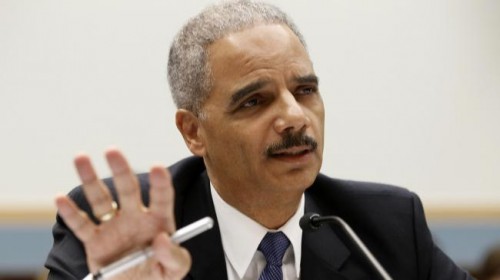
Attorney General Eric H. Holder Jr. announced on Thursday that the Justice Department would ask a court to require Texas to get permission from the federal government before making voting changes in that state for the next decade. The move opens a new chapter in the political struggle over election rules after the Supreme Court struck down a portion of the Voting Rights Act last month.
In a speech before the National Urban League in Philadelphia, Mr. Holder also indicated that the court motion — expected to be filed later on Thursday — is most likely just an opening salvo in a new Obama administration strategy to try to reimpose “preclearance” requirements in parts of the country that have a history of discriminating against minority voters.
His statements come as states across the South, from Texas to North Carolina, have been rushing to enforce or enact new restrictions on voting eligibility after the Supreme Court’s ruling in the Shelby County v. Holder case, which removed that safeguard.
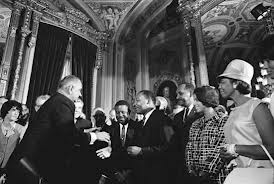
“This is the department’s first action to protect voting rights following the Shelby County decision, but it will not be our last,” Mr. Holder said. “Even as Congress considers updates to the Voting Rights Act in light of the court’s ruling, we plan, in the meantime, to fully utilize the law’s remaining sections to subject states to preclearance as necessary. My colleagues and I are determined to use every tool at our disposal to stand against such discrimination wherever it is found.”
State officials have celebrated the ruling as lifting an obsolete relic of the civil rights era that unfairly treated their states differently than other parts of the country, while civil rights advocates have lamented it as removing a safeguard that is still necessary. Lawyers for minority groups have already asked courts to return Texas to federal oversight. (…)
Richard H. Pildes, a New York University professor who specializes in election law issues, said, (…) “If this strategy works it will become a way of partially updating the Voting Rights Act through the courts. The Justice Department is trying to get the courts to step into the role the Justice Department played before the Shelby County decision. The Voting Rights Act has always permitted this, in some circumstances, but this strategy wasn’t used much. If this approach works, it will help update the Voting Rights Act even without Congressional action.”
Read the full story here.
Read more Breaking News here.
Comments Are Welcome
Note: We moderate submissions in order to create a space for meaningful dialogue, a space where museum visitors – adults and youth –– can exchange informed, thoughtful, and relevant comments that add value to our exhibits.
Racial slurs, personal attacks, obscenity, profanity, and SHOUTING do not meet the above standard. Such comments are posted in the exhibit Hateful Speech. Commercial promotions, impersonations, and incoherent comments likewise fail to meet our goals, so will not be posted. Submissions longer than 120 words will be shortened.
See our full Comments Policy here.
This is promising. Unfortunately, the appeals process leads us back to D.C., right?