Here’s what really happened on Juneteenth
Share
Explore Our Galleries









Breaking News!
Today's news and culture by Black and other reporters in the Black and mainstream media.
Ways to Support ABHM?
By Robin Washington, Forward
And here’s why it’s time for supremacists and their sympathizers to surrender
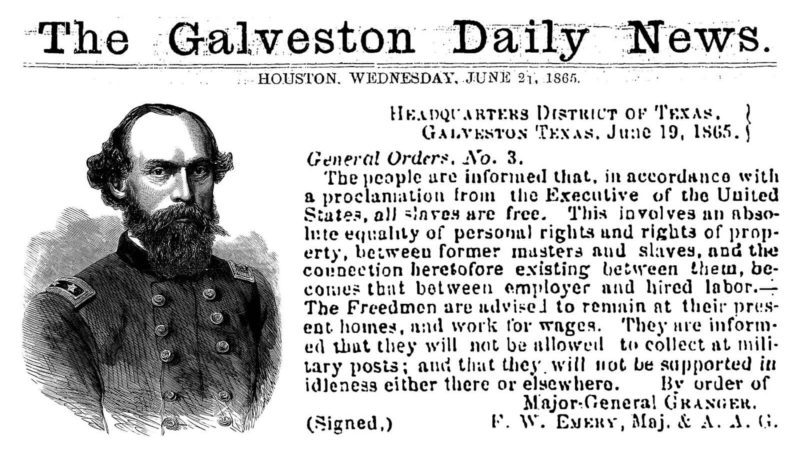
I have participated in Juneteenth observations for years, long before its designation as a national holiday in 2021. And for years, the prevailing narrative behind the holiday – that it marks the day when enslaved African Americans learned they were free after the end of the Civil War – left me with bittersweet feelings at best.
Last year, those feelings turned to outrage.
My change in emotion came after learning from historian friends that the oft-repeated tale of Union soldiers arriving in Galveston, Texas, on June 19, 1865, to tell slaves of their freedom is pure fiction. Not because they weren’t legally freed 2 1/2 months earlier, when Confederate Gen. Robert E. Lee surrendered at Appomattox. Or because they were technically freed 2 1/2 years before, when President Lincoln issued the Emancipation Proclamation, declaring slavery null and void in areas under rebellion, very much including Texas.
Rather, I now know, the big lie is the incessantly repeated canard that Galveston’s po’ ign’ant Black folks didn’t know they was free, and that U.S. Major Gen. Gordon Granger had to read a proclamation to spell it out for them.
In fact, they most certainly did know.
“We knowed what was goin’ on in [the war] all the time,” Felix Haywood, who was enslaved in Texas, is recorded as saying in an account by historian Gregory P. Downs.
Haywood was in no way an anomaly, but representative of the majority of the enslaved populace, Downs asserts. He further quotes Haywood saying, “We all felt like heroes and nobody had made us that way but ourselves.”
If Galveston’s Blacks already knew they were free, obviously their slaveholders did, too — yet nonetheless kept them in bondage, not by cunning or deceit or ignorance, but by the brute force and tactics of dehumanizing torture they had been using for 200 years.
Keep reading to discover how slaveholders disregarded the end of slavery until the last possible moment.
Finally free, Black Americans began to form communities. While the government recognizes the importance of Juneteenth, celebrations have received criticism in other ways.
More Black history and culture news here.
Comments Are Welcome
Note: We moderate submissions in order to create a space for meaningful dialogue, a space where museum visitors – adults and youth –– can exchange informed, thoughtful, and relevant comments that add value to our exhibits.
Racial slurs, personal attacks, obscenity, profanity, and SHOUTING do not meet the above standard. Such comments are posted in the exhibit Hateful Speech. Commercial promotions, impersonations, and incoherent comments likewise fail to meet our goals, so will not be posted. Submissions longer than 120 words will be shortened.
See our full Comments Policy here.