Henrietta Lacks: The Mother of Modern Medicine
Share
Explore Our Galleries









Breaking News!
Today's news and culture by Black and other reporters in the Black and mainstream media.
Ways to Support ABHM?
By Anna MacDonald, Technology Networks.com
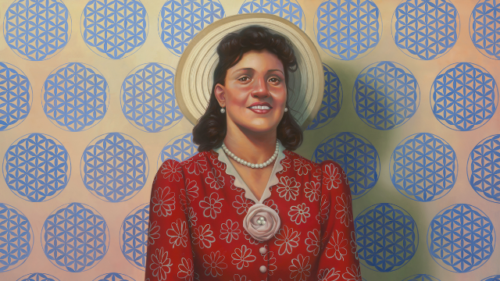
Henrietta Lacks (HeLa): The Mother of Modern Medicine” by Kadir Nelson, oil on linen, 2017. Collection of the Smithsonian National Portrait Gallery and National Museum of African American History and Culture, Gift from Kadir Nelson and the JKBN Group LLC.
A portrait of Henrietta Lacks has recently been unveiled at the Smithsonian’s National Portrait Gallery, to recognize her life and the vital contributions HeLa cells have made to science. The oil on linen painting, The Mother of Modern Medicine, was produced by artist Kadir Nelson in 2017, and will be on view until November 4th. Commissioned by HBO, the painting will be jointly shared with the National Museum of African American History and Culture. “It is fitting that Henrietta Lacks be honored at two Smithsonian museums, as each approaches American history from unique and complementary perspectives,” Kim Sajet, director of the National Portrait Gallery said in a press release.
Who was Henrietta Lacks?
Unlike the HeLa cell line named after her, Henrietta Lacks was little heard of until Rebecca Skloot’s book, The Immortal Life of Henrietta Lacks, published in 2010, brought her story into the spotlight. Born in 1920 in Virginia, Henrietta was an African American tobacco farmer, a wife and mother to 5 children. In 1951, aged just 31 years, Henrietta died from an aggressive form of cervical cancer, only 10 months after first seeking treatment at Johns Hopkins for a “knot” in her womb. During her treatment at the hospital, samples of cancerous tissue were taken from her cervix. These cells went on to become the immortal cell line known as HeLa.
The Significance of HeLa Cells
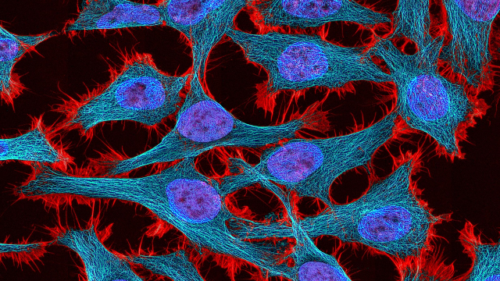
Multiphoton fluorescence image of HeLa cells stained with the actin binding toxin phalloidin (red), microtubules (cyan) and cell nuclei (blue). Credit: National Institutes of Health (Creator: Tom Deerinck, NIGMS, NIH)
Inscribed on Henrietta’s gravestone, (which was donated nearly 60 years after her death), are the words ‘Her immortal cells will continue to help mankind forever.’ And indeed, Henrietta’s cells have already helped to advance numerous fields of science and medicine. The cells were the first that were observed to divide multiple times without dying and enabled Dr. George Gey to start the first immortal Subsequent discoveries and developments resulting from their use include the polio vaccine, AIDS research, gene mapping, IVF, and cloning to name a few. HeLa cells have also traveled to space to test the effects of micro-gravity on cells…
Read the full article here
More about Henrietta Lacks here
Read more Breaking News here
View more galleries from the ABHM here
Comments Are Welcome
Note: We moderate submissions in order to create a space for meaningful dialogue, a space where museum visitors – adults and youth –– can exchange informed, thoughtful, and relevant comments that add value to our exhibits.
Racial slurs, personal attacks, obscenity, profanity, and SHOUTING do not meet the above standard. Such comments are posted in the exhibit Hateful Speech. Commercial promotions, impersonations, and incoherent comments likewise fail to meet our goals, so will not be posted. Submissions longer than 120 words will be shortened.
See our full Comments Policy here.