Ferguson Has Awakened a Larger Struggle for Racial and Economic Justice in America
Share
Explore Our Galleries









Breaking News!
Today's news and culture by Black and other reporters in the Black and mainstream media.
Ways to Support ABHM?
By Peniel E. Joseph, The Root
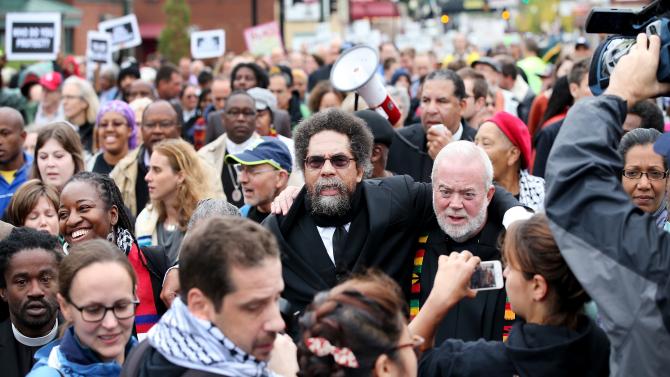
There’s a social-justice movement taking hold across the nation. Michael Brown’s death, which turned Ferguson, Mo., into a battleground this past summer, has helped catalyze a larger struggle for racial and economic justice in America.
And St. Louis, where 18-year-old Vonderrit Myers Jr. was shot and killed by an off-duty police officer, has witnessed roiling street demonstrations that recall the heyday of the civil rights and black power eras. Taking a page straight from the civil rights era, activists launched a “weekend of resistance” that featured civil disobedience, direct action protests, tense standoffs with police and arrests.
The issues raised—ending police brutality, raising the minimum wage, transforming race relations—attracted a cross-generational group of activists. Dozens of protesters stood outside Busch Stadium and reminded baseball fans of the political stakes that dwarfed the outcome of a Major League Baseball playoff game. “This is not a happy time,” one demonstrator told the New York Times. “They come here and watch a baseball game while we die; we go out and get pepper sprayed and hit with tear gas for peaceful protesting.”
Ferguson’s legacy has triggered outrage and inspiration. Young people, from St. Louis to California, Chicago to Boston, have become re-engaged in the political process.
They’re forging a new vision of democracy in America—one found on city streets where too many young black people fall victim to police shootings, and even larger numbers face burdens of poverty and failing public schools. They recognize that America’s criminal-justice system is incapable of recognizing black humanity, let alone our citizenship.
A generational divide still exists, however, between old- and new-school civil rights activists, with younger people at times chafing at the outsize presence of veteran organizers and older folks—sometimes forgetting the audaciousness and impatience of their younger selves. But a cross-section of activists, from NAACP presidents to rappers, have developed a working relationship that promises to help turn outrage into substantive policy transformation.
We stand at a pivotal moment in American history. Brown’s death picked at the scab of larger questions of racial and economic inequality that haunt the nation. And African Americans, as usual, have been called to the front lines in the ongoing struggle to press their country to live up to its democratic ideals.
Read full article here.
Learn about the Civil Rights Movement.
Read more Breaking News here.
Comments Are Welcome
Note: We moderate submissions in order to create a space for meaningful dialogue, a space where museum visitors – adults and youth –– can exchange informed, thoughtful, and relevant comments that add value to our exhibits.
Racial slurs, personal attacks, obscenity, profanity, and SHOUTING do not meet the above standard. Such comments are posted in the exhibit Hateful Speech. Commercial promotions, impersonations, and incoherent comments likewise fail to meet our goals, so will not be posted. Submissions longer than 120 words will be shortened.
See our full Comments Policy here.