Economic Oppression in the Jim Crow System
Share
Explore Our Galleries
Breaking News!
Today's news and culture by Black and other reporters in the Black and mainstream media.
Ways to Support ABHM?
Griot: Russell Brooker, PhD
Copy Editors: Nancy Kaplan, PhD and Jeffrey Schmid


Southern blacks were oppressed economically in several ways: in agriculture and in the workplaces. In addition, they were often punished if they were economically successful.
Agriculture
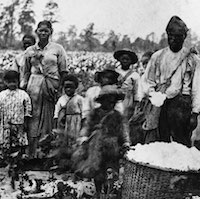
Most blacks in the beginning decades of Jim Crow lived on farms. While some black families did own their own land, most were renters or sharecroppers. Sharecropping was a very exploitative system that victimized millions of black farmers. In the sharecropping system, white landowners, the planters, would provide farmers with land, equipment, seed, food, and medical care. The farmer would buy what he needed at the plantation store, but typically would not know the prices; only the planter kept the books on the cost of expenses. After harvest, the farmer would give the cotton to the planter to sell. The farmer would receive a share of the selling price, and the planter would keep his share. (The planter would sell the cotton seeds, but would not include that income in the farmer’s share.) But before the farmer received his share, the planter would deduct all the farmer’s expenses for the year. Since only the planter had records of the farmer’s expenses, only he knew how much the farmer owed. After calculating the farmer’s share and deducting expenses, the planter would tell the farmer what his final total was. The farmer would have no way of checking on the planter, and he could be beaten or killed for trying. The planter might be honest, or not honest; the farmer had no way of knowing.
Ray Sprigle, a white reporter, wrote in 1949 of a black farmer named Henry (1949, 33-34):
“In all his sharecropping, Henry has never seen any kind of account of his operations. ‘The Man’ never gives him a statement – no figures – just hands him a check or a little roll of cash. Henry never has had a bill or account of his purchases at the commissary. He has never known what his cotton or corn or peanuts sold for. Technically, half of the crop he raises is his. But he never has sold an ounce of cotton or a single peanut.”
Many sharecroppers never did end up with a profit at the end of any year. For them, sharecropping was a treadmill of unending debt. Farmers in debt were sometimes forced to stay on a planter’s plantation until the debt was paid back. Of course, since the planter controlled when and if the debt was paid back, the debt might never be satisfied. Requiring a person to continue working against his will to pay off a debt is called “peonage.” Although the U.S. Supreme Court outlawed peonage in 1911 (Bailey v. Alabama) as a form of slavery and therefore a violation of the 13th Amendment, some sharecroppers were held as virtual slaves in the early 20th century.
Workplace
In the workplace, there were white jobs and Negro jobs. Most of the Negro jobs were menial. Robert A. Margo summed up the situation of white and black non-agricultural jobs (1990, 95):
“Whites simply refused to work for a black foreman. Black access to apprenticeship and training programs in the skilled blue-collar trades was jealously restricted by prejudiced employees, employers, and trade unions. White employers did not hire blacks in retail sales or office work because white customers or clients would be offended.”
When both black and white employees held the same job, blacks were paid less. For example, some counties had both white and black agricultural agents; white agents were paid more. As already noted, white public school teachers were paid more than their black counterparts.
There was the beginning of a black middle class, made up of teachers, preachers, physicians, dentists, beauticians, and others, but it was very small.
Punishment for success
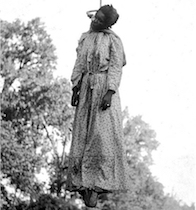
When blacks were successful, it was to their advantage to hide their prosperity from the local whites. Successful black farmers were beaten or even lynched because they drove new buggies or automobiles. As W.E.B. Du Bois wrote, “There was one thing that the white South feared more than Negro dishonesty, ignorance, and incompetency, and that was Negro honesty, knowledge, and efficiency.” (cited in Litwak, 1998, xiv)
Conclusion
The Jim Crow system worked to keep blacks ignorant and unskilled so that they would always be available as cheap laborers. However, the effects of the system also hurt most white people. Most whites were poor. Most of their salaries were low and most white schools were bad. Most whites also had poor health. But black people had even lower salaries, worse schools, and poorer health. The Jim Crow system really helped only wealthy white people.
Russell G. Brooker, PhD, is Professor of Political Science at Alverno College, in Milwaukee, Wisconsin. He teaches courses in political science, and research methodology. He has taught courses in African American history, Jim Crow, and the Civil Rights Movement since 1981. He is currently writing a book on the civil rights movement before 1954.
Comments Are Welcome
Note: We moderate submissions in order to create a space for meaningful dialogue, a space where museum visitors – adults and youth –– can exchange informed, thoughtful, and relevant comments that add value to our exhibits.
Racial slurs, personal attacks, obscenity, profanity, and SHOUTING do not meet the above standard. Such comments are posted in the exhibit Hateful Speech. Commercial promotions, impersonations, and incoherent comments likewise fail to meet our goals, so will not be posted. Submissions longer than 120 words will be shortened.
See our full Comments Policy here.