Cultivating Tulsa’s Equitable Future
Share
Explore Our Galleries









Breaking News!
Today's news and culture by Black and other reporters in the Black and mainstream media.
Ways to Support ABHM?
Summary of Breanna Draxler’s article “Growing a Just Future in Tulsa” published by Yes! on May 31st, 2023.
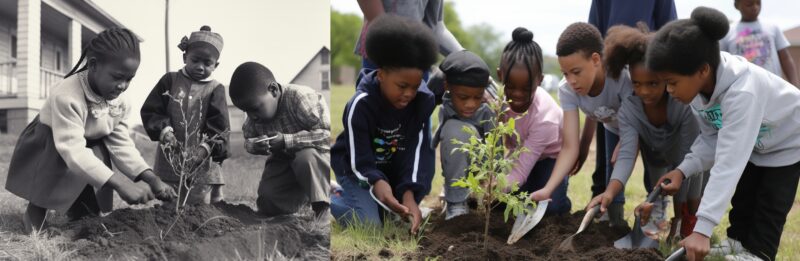
Right: Project Seads and Tulsa’s Carver Middle School children plant elm seedlings and hope throughout Tulsa, OK, home of the 1921 race massacre. / photo credit: Justus Selah in collaboration with AI.
The ancient elm tree sitting on the grounds of Carver Middle School in Tulsa, Oklahoma was dedicated as a memorial to mark the centennial of the Tulsa race massacre in 1921. It was alive before the school was erected, and before the entire Greenwood neighborhood was leveled by a violent white mob leaving approximately 300 black residents dead and over 10,000 people homeless.
Bryan Meador, a designer and the founder of the Plant Seads project, invited students from Carver Middle School and the Tulsa community at large to pick up about 100 elm seedlings to plant all over the city. He wanted to acknowledge the past and give people a sense that change and real sustaining growth is possible. He believes trees are a powerful opportunity for community healing and community building. The April tree-planting event was one of many projects supported by the 1921 Tulsa Race Massacre Centennial Commission to honor the legacy and resilience of the Greenwood District.
The seedlings distributed as part of the project were grown in partnership between the nonprofit Up With Trees and the Dick Conner Correctional Center located 40 miles northwest of Tulsa. Up With Trees, alone, has planted 40,000 trees around Tulsa this past half-century. The lasting impact of the project won’t be limited to just trees, but it also includes the lives and dignity of incarcerated people at the correctional center, including horticulture student Darrell Elliott. He planted these elm seedlings to commemorate the people who lost their lives 100 years ago.
The April tree-planting event was one of many projects supported by the 1921 Tulsa Massacre Centennial Commission to honor the legacy and resilience of the Greenwood District. Glenda Love-Williams, the co-chair of fundraising for the Tulsa Massacre Centennial Commission, said that planting the seeds of reconciliation, hope, and love is just as central to the project as cultivating tress. Love-Williams and the commission are working to create a vision of a thriving Greenwood once again, by hosting events, building a Black Wall Street History Center, promoting economic empowerment, and making the case for reparations.
The Oklahoma State Department of Education has developed a new K-12 curriculum to teach students about the causes and ongoing ramifications of the massacre at every grade level, and Tulsa Public Schools plans to start using the new curriculum in May. Meador sees the goal of centennial projects like his tree-planting event as a key part of this commitment to the future of the community.
Read the source article here.
Read more about the Tulsa race massacre here.
For more Breaking News click here.
Comments Are Welcome
Note: We moderate submissions in order to create a space for meaningful dialogue, a space where museum visitors – adults and youth –– can exchange informed, thoughtful, and relevant comments that add value to our exhibits.
Racial slurs, personal attacks, obscenity, profanity, and SHOUTING do not meet the above standard. Such comments are posted in the exhibit Hateful Speech. Commercial promotions, impersonations, and incoherent comments likewise fail to meet our goals, so will not be posted. Submissions longer than 120 words will be shortened.
See our full Comments Policy here.