CIA honors Underground Railroad and Civil War hero Harriet Tubman as a model spy with a new statue
Share
Explore Our Galleries









Breaking News!
Today's news and culture by Black and other reporters in the Black and mainstream media.
Ways to Support ABHM?
By Dan De Luce, NBC
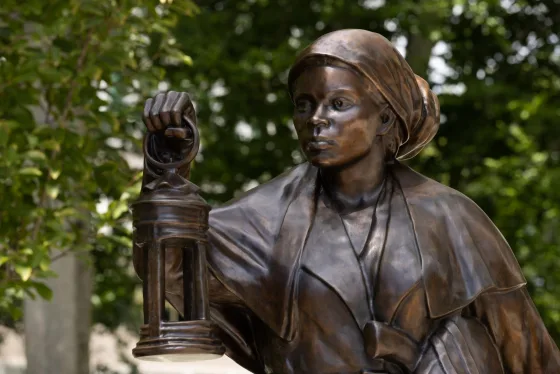
When CIA employees walk into their headquarters in suburban Virginia, they are now greeted by a young Black woman. She’s holding a lantern and armed with a pistol in her belt, looking fearless.
The woman is Harriet Tubman, a hero of the Underground Railroad, portrayed in a striking bronze statue recently unveiled at the Central Intelligence Agency in Langley.
The idea for the statue came from CIA officers who studied Tubman in a leadership class, including her time spying for the Union Army during the Civil War.
Seeing her as a skilled covert operator, the officers urged the agency to add a statue of Tubman to the sculptures already on the agency’s campus, officials said.
“What she did was an example of intelligence work, going behind enemy lines, using safe houses and signals intelligence to get people to freedom,” said Robert Beyer, director of the CIA’s museum.
Tubman operated with ingenuity, stealth, courage and selflessness, Beyer said. “These are all traits we want our officers to embody.”
Read about the new statue.
Tubman has also been honored through a 400-mile walk and having schools and highways named after her.
Comments Are Welcome
Note: We moderate submissions in order to create a space for meaningful dialogue, a space where museum visitors – adults and youth –– can exchange informed, thoughtful, and relevant comments that add value to our exhibits.
Racial slurs, personal attacks, obscenity, profanity, and SHOUTING do not meet the above standard. Such comments are posted in the exhibit Hateful Speech. Commercial promotions, impersonations, and incoherent comments likewise fail to meet our goals, so will not be posted. Submissions longer than 120 words will be shortened.
See our full Comments Policy here.