Celebrating the ‘complete’ Martin Luther King Jr.; unfinished work and all
Share
Explore Our Galleries









Breaking News!
Today's news and culture by Black and other reporters in the Black and mainstream media.
Ways to Support ABHM?
By Blair L. M. Kelley, theGrio
My 9-year old daughter came home this week raving about her class and their discussion of Martin Luther King, Jr.
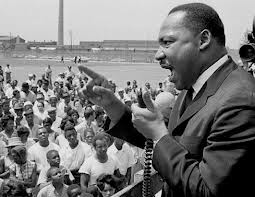
She declared that she loved learning about his life and that she was thankful to him because without King, no change would have been possible in America on the question of race. I am a historian of African-American history specializing in social movements, so I quickly moved to correct her. Of course change would have happened, even if King had never lived! I described to her other leaders. I reminded her that movements don’t function because of just one great man. I told her that King was not a perfect person, and that even he had come short of meeting all his goals. In the end, I even resorted to reminding her that I wrote a book on a movement that took place 35 years before King was even born.
Clearly my daughter didn’t care. She insisted that her school would not be integrated, and that her whole world would not have been the same without King’s leadership.
After thinking about it for a while, I realized that most people feel the same way about King that my daughter does.
[…]
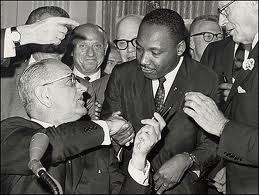
As an icon, King is often thought of as flawless, so that we rarely reflect on his failures as a movement leader. Our collective memory of King only touches on the high points…We tend not to remember the moments when King faltered or searched for the right direction. We don’t recall the indecision about what to do next after the success of the Montgomery Bus Boycott; the challenge of the 1966 Chicago Freedom Movement campaign, or his unfulfilled Poor People’s Campaign — cut short by his tragic assassination in 1968. These moments are forgotten when King is not remembered in his broader context.
It is especially telling that Chicago, Illinois was the site of one of King’s most difficult campaigns. King and his organization, the Southern Christian Leadership Conference, were drawn into the struggle in the urban North after the Los Angeles riots of 1965. While the southern movement had been making strides in dismantling segregation and disfranchisement, the problems of black residents in the urban North and West had not gained sustained national attention.
Read about Dr. King’s Chicago campaign – and more – here.
Read more Breaking News here.
Comments Are Welcome
Note: We moderate submissions in order to create a space for meaningful dialogue, a space where museum visitors – adults and youth –– can exchange informed, thoughtful, and relevant comments that add value to our exhibits.
Racial slurs, personal attacks, obscenity, profanity, and SHOUTING do not meet the above standard. Such comments are posted in the exhibit Hateful Speech. Commercial promotions, impersonations, and incoherent comments likewise fail to meet our goals, so will not be posted. Submissions longer than 120 words will be shortened.
See our full Comments Policy here.
Hi there! This post could not be written any better!
Reading this pokst reminds me of my previouhs room mate! He alwas kept talking about this.
I will forward this article to him. Pretty sure he will have a good read.
Many thanks for sharing!
Highly descriptive blog, I likied that bit.
Will there be a part 2?