Washington state Black students played key role in the Civil Rights Movement
Share
Explore Our Galleries









Breaking News!
Today's news and culture by Black and other reporters in the Black and mainstream media.
Ways to Support ABHM?
Marc Arsell Robinson, The Conversation
Washington isn’t a state that typically comes into mind in discussions about student-led protests from the Civil Rights Movement.
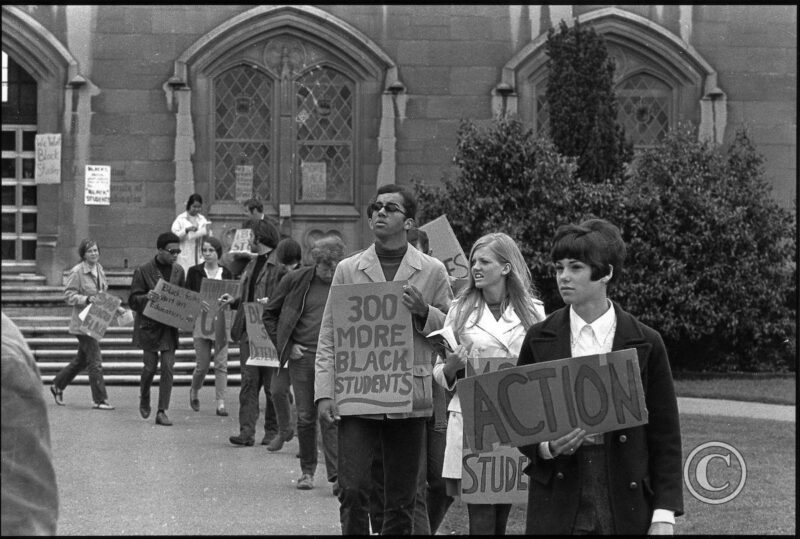
A protest led by the Black Student Union at the University of Washington at Seattle, 1968. Emile Pitre Collection
“‘When it comes to civil rights history, the focus is often on the marches, boycotts, sit-ins and other protests that took place in the South. In “Washington State Rising,” Marc Arsell Robinson, assistant professor of African American history at California State University, San Bernardino, takes a look at the civil rights protests that occurred in a lesser-examined region of the United States: The Pacific Northwest. The following Q&A is about what Robinson found for his forthcoming book, which is set to be published in August 2023.'”
[…]
The Black Student Union, or BSU, at the University of Washington helped connect the Black Panther Party to Seattle. The group formed in fall 1967, and later several of its members helped co-found the Seattle Panthers in April 1968. … Studies of Black protests from the 1960s tend to focus on the South. And even studies of civil rights events and groups outside the South position the Pacific Northwest as marginal. This pattern holds true of research on 1960s Black student activism, such as the studies of nationwide protest by Ibram X. Kendi and Matha Biondi.
[…]
Black Student Unions are active at numerous colleges and universities in Washington, including the two schools featured in [“Washington State Rising”], the University of Washington and Washington State University. Like their 1960s counterparts, progressive Black students today continue to push their institutions to create, maintain and expand initiatives to graduate Black students, hire Black faculty and fund Black studies and related curricula.”
Check out the original article.
Want to know more about civil rights activists? The bibliography for I Am Somebody! The Struggle For Justice is a great place to start!
Comments Are Welcome
Note: We moderate submissions in order to create a space for meaningful dialogue, a space where museum visitors – adults and youth –– can exchange informed, thoughtful, and relevant comments that add value to our exhibits.
Racial slurs, personal attacks, obscenity, profanity, and SHOUTING do not meet the above standard. Such comments are posted in the exhibit Hateful Speech. Commercial promotions, impersonations, and incoherent comments likewise fail to meet our goals, so will not be posted. Submissions longer than 120 words will be shortened.
See our full Comments Policy here.