Black doctors see hope in TV’s ‘Doc McStuffins’
Share
Explore Our Galleries









Breaking News!
Today's news and culture by Black and other reporters in the Black and mainstream media.
Ways to Support ABHM?
From the Grio.com
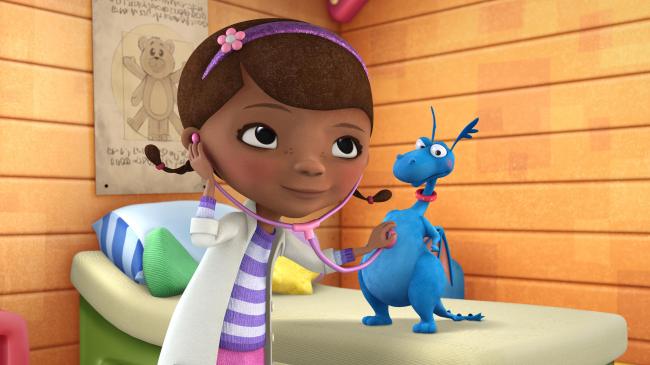
A pig-tailed girl whose favorite accessory is a pink stethoscope has become a symbol of pride and hope for black women in medicine and the daughters they want to inspire.
Doc McStuffins, the African-American title character of an animated TV series for children, dreams of becoming an M.D. and, for now, runs a cheerful home clinic for stuffed animals and dolls.
“I haven’t lost a toy yet!” Doc exclaims as she hugs a blue dinosaur in need of attention.
For Dr. Myiesha Taylor, who watches Disney Channel’s “Doc McStuffins” with her 4-year-old, Hana, the show sends a much-needed message to minority girls about how big their ambitions can be.
“It’s so nice to see this child of color in a starring role, not just in the supporting cast. It’s all about her,” Taylor said. “And she’s an aspiring intellectual professional, not a singer or dancer or athlete.”
So Taylor sent a message back, creating an online collage featuring an image of the buoyant Doc encircled by photos of 131 black women who are Doc’s real life-counterparts, most garbed in their scrubs or doctor’s coats.
“We are trailblazers,” Taylor proclaimed on her website. “We are women of color. We are physicians. We ARE role-models. We are Doc McStuffins all grown up!”
For black women whose own wish to practice medicine came true, the show is welcome affirmation. The doctors shown in the collage are graduates of schools including Harvard, Yale and Stanford and work in a range of specialties such as neurosurgery, orthopedic surgery and psychiatry. Taylor is a board-certified emergency room physician.
According to the American Medical Association’s “Physician Characteristics and Distribution in the U.S., 2012 Edition,” there were 18,533 black female physicians in 2010, or less than 2 percent of a total of 985,375 U.S. doctors, including nearly 300,000 female physicians. According to the 2010 U.S. Census, blacks make up 12.3 percent of the population at about 40 million, with more than half of them women.
“When we made her an African-American girl, we hoped it would be a positive role model that wasn’t really out there and would be great for little girls,” said series creator Chris Nee, who said she was encouraged by Disney from the start to create Doc as a minority character. “What has been surprising is the strength of the reaction and that it’s from adults.”
She hopes the series resonates with all the girls who watch it, she added, citing worrisome studies that females start to develop negative attitudes about science at a young age.
Read more of the story here.
Representations like this are important, but Black creators also need to be heard.
Comments Are Welcome
Note: We moderate submissions in order to create a space for meaningful dialogue, a space where museum visitors – adults and youth –– can exchange informed, thoughtful, and relevant comments that add value to our exhibits.
Racial slurs, personal attacks, obscenity, profanity, and SHOUTING do not meet the above standard. Such comments are posted in the exhibit Hateful Speech. Commercial promotions, impersonations, and incoherent comments likewise fail to meet our goals, so will not be posted. Submissions longer than 120 words will be shortened.
See our full Comments Policy here.