Black Californians don’t see the state’s reparations task force as a guarantee of compensation
Share
Explore Our Galleries









Breaking News!
Today's news and culture by Black and other reporters in the Black and mainstream media.
Ways to Support ABHM?
By Curtis Bunn, NBC News
Black Californians who spoke to NBC News say they think reparations are necessary, but they very much doubt the most effective policies will come to pass.
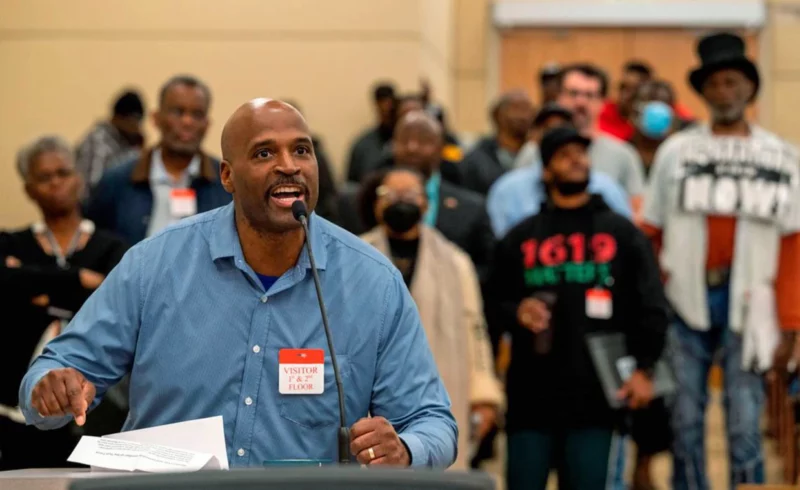
(Lezlie Sterling / Zuma Press)
As the California Reparations Task Force crafts its recommendations to the state Assembly for a vote by July 1, Fahizah Alim is among the countless Black Californians who have seen generations of change in the country’s most populous state — but are still deeply skeptical that compensation for the centuries of racial oppression will materialize in any substantive form.
“Unfortunately, many irrationally see it as a zero-sum game: ‘If we win, then they lose.’ So, I’m not optimistic,” she said. “Hopeful, but not optimistic. Even in liberal California, the status quo runs deep, and that’s white folks on top and Black folks on the bottom.”
The nine-member task force, impaneled by Gov. Gavin Newsom, has been at work for almost two years, researching the depth of the harms of racism on Black people while also deploying a cadre of economists to calculate, in dollars, the impact of the damages. Members have made it clear that no amount of financial restitution can measure up to the devastation of slavery and the subsequent forces of it.
But most Black Californians interviewed by NBC News made two things clear: One, they want money as a major part of reparations, and two, they very much doubt they will get their wish. “As Dr. Martin Luther King, Jr., said in a famous speech, we’re coming for our check,” said Maureen Simmons, who as an intern for state Assembly member Shirley Weber, completed research that led to AB 3121, the bill to create the Reparations Task Force. Despite their desire for financial restitution, most Black Californians remain incredulous.
“I’m laughing because it’s pretty foolish for any Black person in America to wholeheartedly believe that reparations will come to us in the form of a financial payment that will be fair compared to what slavery did to our people and, really, did to us,” said Ron Finney, an entrepreneur in San Diego said. “We can hope for something, but it’s hope. Not to be pessimistic, but we can’t be optimistic about anything. And why’s that? Because of the history of how Black people have been treated, from slavery to now. So, I’d be surprised if we received anything.”
The task force’s recommendations will be evaluated by state lawmakers to introduce bills, which would still have to be passed by the Legislature and signed into law by Newsom. Members have said they are weighing whether to recommend payouts to individuals. “But we’re going to make recommendations on many areas that I think will have a longer lasting impact on African American life,” said committee member Reginald Sawyer-Jones, an assembly member.
Receiving money as part of reparations, though, is critical to creating generational wealth, many said.
Click here to read the whole story and find out why residents are skepticle
Click here to read about the 1619 project and the case for reparations.
To find out how the fight for Civil Rights and Equality continue today, explore the Black Holocaust Museums exhibit on Racial Repair and Reconciliation
Comments Are Welcome
Note: We moderate submissions in order to create a space for meaningful dialogue, a space where museum visitors – adults and youth –– can exchange informed, thoughtful, and relevant comments that add value to our exhibits.
Racial slurs, personal attacks, obscenity, profanity, and SHOUTING do not meet the above standard. Such comments are posted in the exhibit Hateful Speech. Commercial promotions, impersonations, and incoherent comments likewise fail to meet our goals, so will not be posted. Submissions longer than 120 words will be shortened.
See our full Comments Policy here.