Black Artists Say A.I. Shows Bias, With Algorithms Erasing Their History
Share
Explore Our Galleries









Breaking News!
Today's news and culture by Black and other reporters in the Black and mainstream media.
Ways to Support ABHM?
By Zachary Small, New York Times
Tech companies acknowledge machine-learning algorithms can perpetuate discrimination and need improvement.
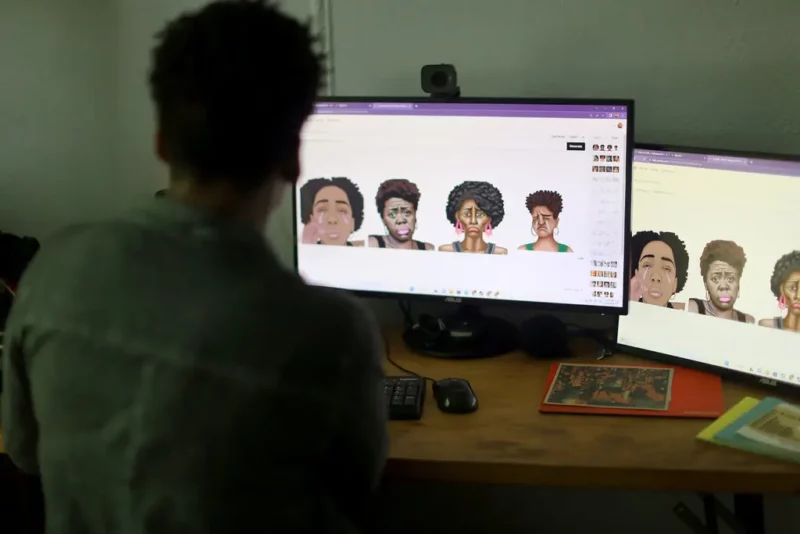
The artist Stephanie Dinkins has long been a pioneer in combining art and technology in her Brooklyn-based practice. In May she was awarded $100,000 by the Guggenheim Museum for her groundbreaking innovations, including an ongoing series of interviews with Bina48, a humanoid robot.
For the past seven years, she has experimented with A.I.’s ability to realistically depict Black women, smiling and crying, using a variety of word prompts. The first results were lackluster if not alarming: Her algorithm produced a pink-shaded humanoid shrouded by a black cloak.
“I expected something with a little more semblance of Black womanhood,” she said. And although the technology has improved since her first experiments, Dinkins found herself using runaround terms in the text prompts to help the A.I. image generators achieve her desired image, “to give the machine a chance to give me what I wanted.” But whether she uses the term “African American woman” or “Black woman,” machine distortions that mangle facial features and hair textures occur at high rates.
“Improvements obscure some of the deeper questions we should be asking about discrimination,” Dinkins said. The artist, who is Black, added, “The biases are embedded deep in these systems, so it becomes ingrained and automatic. If I’m working within a system that uses algorithmic ecosystems, then I want that system to know who Black people are in nuanced ways, so that we can feel better supported.”
She is not alone in asking tough questions about the troubling relationship between A.I. and race. Many Black artists are finding evidence of racial bias in artificial intelligence, both in the large data sets that teach machines how to generate images and in the underlying programs that run the algorithms. In some cases, A.I. technologies seem to ignore or distort artists’ text prompts, affecting how Black people are depicted in images, and in others, they seem to stereotype or censor Black history and culture.
Small discusses these questions here.
Algorithms may also contribute to medical racism.
Stop by our breaking news page before you leave!
Comments Are Welcome
Note: We moderate submissions in order to create a space for meaningful dialogue, a space where museum visitors – adults and youth –– can exchange informed, thoughtful, and relevant comments that add value to our exhibits.
Racial slurs, personal attacks, obscenity, profanity, and SHOUTING do not meet the above standard. Such comments are posted in the exhibit Hateful Speech. Commercial promotions, impersonations, and incoherent comments likewise fail to meet our goals, so will not be posted. Submissions longer than 120 words will be shortened.
See our full Comments Policy here.