Bills’ Hamlin in critical condition after collapse on field
Share
Explore Our Galleries









Breaking News!
Today's news and culture by Black and other reporters in the Black and mainstream media.
Ways to Support ABHM?
By Mitch Stacy, Associated Press
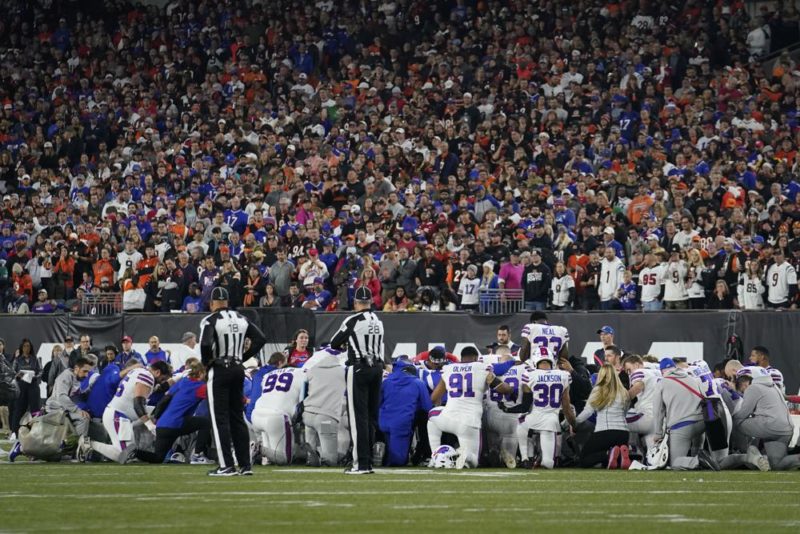
CINCINNATI (AP) — Buffalo defensive back Damar Hamlin was in critical condition early Tuesday after the Bills say his heart stopped following a tackle during the Monday Night Football game, which was indefinitely postponed.
Hamlin collapsed on the field during the first quarter of the nationally televised game against the Cincinnati Bengals and was given medical treatment for nearly 20 minutes before being taken to a hospital.
“Damar Hamlin suffered a cardiac arrest following a hit in our game versus the Bengals. His heartbeat was restored on the field and he was transferred to the UC Medical Center for further testing and treatment,” the Bills said in a statement. “He is currently sedated and listed in critical condition.”
Jordon Rooney, a family representative who described himself as a good friend of the player, told ABC’s “Good Morning America” on Tuesday that Hamlin’s relatives are in good spirits but going through a lot and need their privacy. He declined to give details on Hamlin’s condition other than to say he is sedated.
“All I can say is he’s fighting; he’s a fighter,” Rooney said.
In a chilling scene, Hamlin was administered CPR on the field, ESPN reported, while surrounded by teammates, some of them in tears, while they shielded him from public view. He was hurt while tackling Bengals receiver Tee Higgins on a seemingly routine play that didn’t appear unusually violent.
[…]
On the play the 6-foot, 200-pound Hamlin was injured, Higgins led with his right shoulder, which hit the defensive back in the chest. Hamlin then wrapped his arms around Higgins’ shoulders and helmet to drag him down. Hamlin quickly got to his feet, appeared to adjust his face mask with his right hand and then fell backward about three seconds later and lay motionless.
People typically associate traumatic brain injuries with football. Fans can read R.K. Russell’s memoir for details about the sport.
Find more sports stories on our breaking news page.
Comments Are Welcome
Note: We moderate submissions in order to create a space for meaningful dialogue, a space where museum visitors – adults and youth –– can exchange informed, thoughtful, and relevant comments that add value to our exhibits.
Racial slurs, personal attacks, obscenity, profanity, and SHOUTING do not meet the above standard. Such comments are posted in the exhibit Hateful Speech. Commercial promotions, impersonations, and incoherent comments likewise fail to meet our goals, so will not be posted. Submissions longer than 120 words will be shortened.
See our full Comments Policy here.