AIDS Quilt Returns to Washington
Share
Explore Our Galleries









Breaking News!
Today's news and culture by Black and other reporters in the Black and mainstream media.
Ways to Support ABHM?
By KYLE BLAINE, ABC News
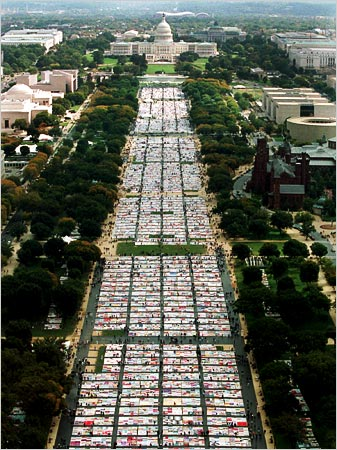
The AIDS Memorial Quilt has returned to Washington, D.C., for the first time in 16 years, marking the 25th anniversary of The NAMES Project and thirty years in the struggle to stop the spread of HIV and AIDS around the world.
Every morning volunteers take on the laborious process of unfolding the panels of the quilt on the National Mall and then packing them up in the evening, a process that can only be described as a labor of love.
The quilt has over 94,000 names of AIDS sufferers on it and has been seen by over 18 million people worldwide. Through tours and special events, the quilt has raised over $4 million for direct services for people living with AIDS.
For the quilt’s creators, this patch of green lawn in the heart of the nation’s capital holds special significance — the quilt was first displayed there in October of 1987 during the National March on Washington for Lesbian and Gay Rights, a time when many felt the federal government was turning its back on the AIDS epidemic.
The quilt is the brainchild of San Francisco gay-rights activist Cleve Jones, who in 1987, helped found The NAMES Project. Today, the quilt consists of 48,000 panels and takes up 1.3 million square feet, making it impossible to view in its entirety at any one time. If a visitor were to spend one minute to view each panel, it would take over 33 days to see the entire quilt.
Read the full article or learn more about the AIDS Memorial Quilt.
Comments Are Welcome
Note: We moderate submissions in order to create a space for meaningful dialogue, a space where museum visitors – adults and youth –– can exchange informed, thoughtful, and relevant comments that add value to our exhibits.
Racial slurs, personal attacks, obscenity, profanity, and SHOUTING do not meet the above standard. Such comments are posted in the exhibit Hateful Speech. Commercial promotions, impersonations, and incoherent comments likewise fail to meet our goals, so will not be posted. Submissions longer than 120 words will be shortened.
See our full Comments Policy here.