Academy Museum’s Show on Black Cinema Raises Questions About Who It’s For
Share
Explore Our Galleries









Breaking News!
Today's news and culture by Black and other reporters in the Black and mainstream media.
Ways to Support ABHM?
By Manohla Dargis, New York Times
“Regeneration” is a worthwhile look at stars and films, but it presents a tale of difficulty and triumph that doesn’t always engage with Hollywood’s history of racism.
In January 1942, Lena Horne signed a contract with Metro-Goldwyn-Mayer. She wasn’t the first Black performer to sign with a major studio, but it was big news, suggesting real change had come to Hollywood. “Lena is ‘different,’” exclaimed one gossip columnist. Another writer optimistically predicted that Horne would “play legitimate roles and not have to do ‘illiterate comedy’ or portray a cook.” Not everyone was onboard, and when Horne showed up on the lot to shoot her first film, MGM’s white hairdressers refused to work with her — Black ones were brought in instead.
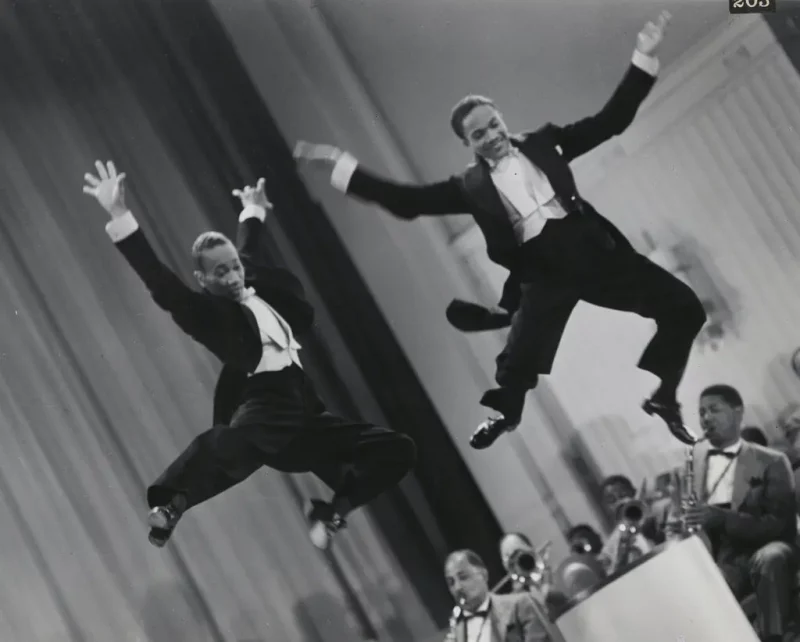
Horne appears several times in the exhibition “Regeneration: Black Cinema 1898-1971,” a sweeping show that’s on view at the Academy Museum in Los Angeles. It’s an exhilarating, complicated endeavor that’s at once impressive for the depth of its scholarship and frustrating in how it elides certain blunt truths about the barriers that Black performers and filmmakers faced in the mainstream industry. Long before Ava DuVernay, long before Spike Lee and the successive waves of Black cinema, Black artists made movies both in apartheid Hollywood and in independent companies of their own.
Curated by Doris Berger and Rhea L. Combs, the exhibition is a significant undertaking for the museum, which opened last fall after many delays, and for its parent institute, the Academy of Motion Picture Arts and Sciences. Although it likes to focus on individual achievements, the academy is a trade organization, one that represents an industry facing deep existential issues that have become only more pronounced during the pandemic. Theatrical attendance was already in decline before Covid hit, as were the number of viewers tuning into the Oscars. And while the organization continues to diversify its membership in the wake of #OscarsSoWhite, the industry as a whole is more resistant.
“Regeneration” is divided into two sections, including an inaugural screening series, a piquant selection that’s nonetheless a disappointingly abbreviated offering, particularly in relation to the expansiveness of the show’s other half. (More programs are promised.) Most of the titles have already screened, but you can still catch two with Sidney Poitier: Joseph L. Mankiewicz’s “No Way Out” (1950), and Daniel Petrie’s devastating adaptation of “A Raisin in the Sun” (1961), which also stars Ruby Dee. This program concludes at the end of September with a 1970s double bill of Robert L. Goodwin’s “Black Chariot” and Melvin Van Peebles’s “Sweet Sweetback’s Baadasssss Song.”
Dargis’ critique explains why Regeneration falls short.
Just this summer, a Broadway theater was renamed after Horne.
Comments Are Welcome
Note: We moderate submissions in order to create a space for meaningful dialogue, a space where museum visitors – adults and youth –– can exchange informed, thoughtful, and relevant comments that add value to our exhibits.
Racial slurs, personal attacks, obscenity, profanity, and SHOUTING do not meet the above standard. Such comments are posted in the exhibit Hateful Speech. Commercial promotions, impersonations, and incoherent comments likewise fail to meet our goals, so will not be posted. Submissions longer than 120 words will be shortened.
See our full Comments Policy here.