A Family Rooted in Two Realms
Share
Explore Our Galleries









Breaking News!
Today's news and culture by Black and other reporters in the Black and mainstream media.
Ways to Support ABHM?
By NEIL GENZLINGER, New York Times
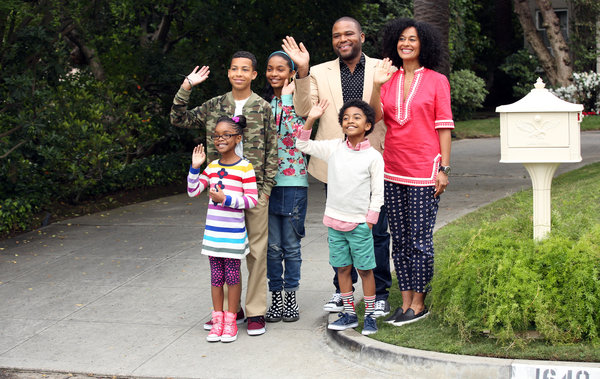
A lot of people in the television business are said to be curious to see how “black-ish,”ABC’s new comedy, is received when it has its premiere on Wednesday night. What they should really be curious about, though, is where the series goes after its funny but talking-point-heavy first episode.
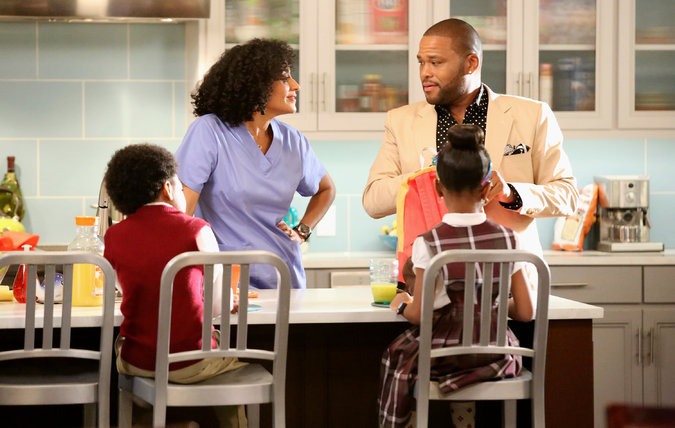
The sitcom centers on a black family in Los Angeles, the Johnsons, struggling with prosperity. Andre (Anthony Anderson) works at an advertising agency; in the premiere, he’s on the verge of a major promotion. Rainbow (Tracee Ellis Ross) is an anesthesiologist. Their four children are smart and adorable.
If this puts you in mind of the Huxtables of “The Cosby Show,” that’s no accident. But more than the Huxtables ever were, the Johnsons are wrestling with whether their comfortable lives are causing them to forget that they’re black.
Well, Andre is doing most of the wrestling. The other family members display varying degrees of indifference to the issue, and therein lies the comedy. Andre, we learn in an introductory voice-over, grew up in less-than-middle-class fashion, and success leaves him conflicted.
“I guess for a kid from the ’hood, I’m living the American dream,” he explains. “The only problem is, whatever American had this dream probably wasn’t where I’m from. And if he was, he should have mentioned the part about how when brothers start getting a little money, stuff starts getting a little weird.”
The episode then visits in rapid succession — always comically — a formidable range of issues Andre encounters as a result of this duality. At work, he worries that he is receiving a promotion only because he’s black. At his computer, he laments that white celebrities are intruding on black culture.
At home, he tells his lighter-skinned wife — a “pigment-challenged mixed-race woman,” he calls her — that she’s not black enough. He is dismayed that his older son is trying out for field hockey instead of basketball. The dinner table discussion (yes, we’ve found the last family in America that still eats together around a dinner table) focuses on whether the children know that Barack Obama is the first black president. Even fried chicken comes in for scrutiny, although not from Andre, but from his father, winningly played by Laurence Fishburne.
Read full article here.
Read more Breaking News here.
Comments Are Welcome
Note: We moderate submissions in order to create a space for meaningful dialogue, a space where museum visitors – adults and youth –– can exchange informed, thoughtful, and relevant comments that add value to our exhibits.
Racial slurs, personal attacks, obscenity, profanity, and SHOUTING do not meet the above standard. Such comments are posted in the exhibit Hateful Speech. Commercial promotions, impersonations, and incoherent comments likewise fail to meet our goals, so will not be posted. Submissions longer than 120 words will be shortened.
See our full Comments Policy here.