Painting Shows Slave-Auction Drama
Share
Explore Our Galleries









Breaking News!
Today's news and culture by Black and other reporters in the Black and mainstream media.
Ways to Support ABHM?
From the Root
An 1861 painting from British artist Eyre Crowe captures the anxiety before a sale.
In May of 1861, a strikingly original painting was exhibited at the annual show of the Royal Academy in London.
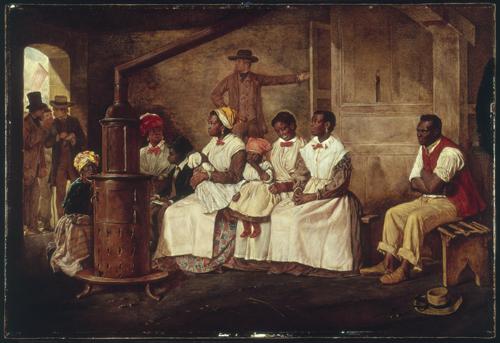
The artist, Eyre Crowe, presented the public with a candid vision of the institution of slavery in the United States: A group of eight black women and young children sit within the dusky interior of a slave sale room. At right, a man is seated separately, his arms tightly folded, with a sober, even angry, look on his face. Behind the main group stands the auctioneer, who looks toward the doorway at the left. Three men have stopped there and seem to be discussing their prospects within. Outside flies a red flag, always put out when a slave sale was proceeding….
[Crowe] had published several other images related to slavery in the British popular press, as well as another painting showing slaves being transported to their new owners by rail. All of these images were based on his direct experience of the “peculiar institution” gained as an assistant to the popular British author William Makepeace Thackeray on an extended speaking tour along the Eastern Seaboard of the United States in 1852-53.
Along the way, he made sketches of his travels. Supplemented by notes from a diary kept during the trip, these formed the basis for a vivid impression of North-South distinctions in the former colonies just before the Civil War. While Thackeray maintained a reserve discrete from the slavery question, Crowe explored it with keen interest.
Fired by his reading of Harriet Beecher Stowe’s just-released Uncle Tom‘s Cabin, and having seen advertisements for slave sales in the Richmond, Va., paper, on the morning of March 3, 1853, he ventured into two of the many slave-auction rooms along Wall Street.
Read more about this painting and its artist here.
Read more Breaking News stories here.
Comments Are Welcome
Note: We moderate submissions in order to create a space for meaningful dialogue, a space where museum visitors – adults and youth –– can exchange informed, thoughtful, and relevant comments that add value to our exhibits.
Racial slurs, personal attacks, obscenity, profanity, and SHOUTING do not meet the above standard. Such comments are posted in the exhibit Hateful Speech. Commercial promotions, impersonations, and incoherent comments likewise fail to meet our goals, so will not be posted. Submissions longer than 120 words will be shortened.
See our full Comments Policy here.