‘We Are Here’: Crusade for More Inclusion of DeafBlind People of Color
Share
Explore Our Galleries









Breaking News!
Today's news and culture by Black and other reporters in the Black and mainstream media.
Ways to Support ABHM?
By Ariama C. Long, New York Amsterdam News
DeafBlind co-navigator programs have been successful in other states, and organizers say it is time that this “world of services” becomes open to New Yorkers.
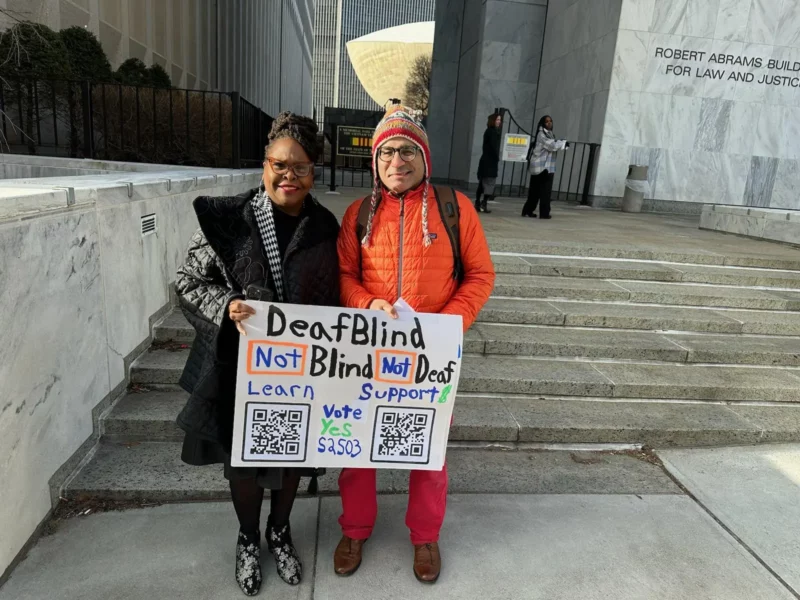
The nation has fallen in love with American Sign Language (ASL) performer Justina Miles, who interpreted for singer Rihanna during this year’s Super Bowl halftime show. But more than just praise for individuals like Miles, local legislators are taking the opportunity to highlight programs that can create real change for disabled communities of color that are often left out of the conversation.
According to data collected from the 2019 American Community Survey (ACS), approximately 2.47 million people have combined hearing and vision loss, or considered DeafBlind under federal guidelines. In New York State (NYS), ACS data indicated that about 120,000 individuals reported combined vision and hearing loss, representing .61% of the state’s population.
The racial breakdown of the state’s DeafBlind ACS data shows there are about 60% white, 13% Black, 18% Hispanic, and 5% Asian. Organizers believe that there is definitely an undercount of disabled people, especially DeafBlind people of color across the state, leading to severe “underfunding” of services compared to other states.
[…]
In NYS, Harlem’s Senator Cordell Cleare and Brooklyn’s Assemblymember Stefani Zinerman are sponsoring bills for a statewide DeafBlind co-navigator program. A co-navigator is specially trained to assist DeafBlind people with jobs, travel, school, and day-to-day activities. They often use tactile sign language in addition to ASL and Braille to help their clients communicate.
“Thanks to the organizing and awareness-raising work of the Black Deaf community and others, we have come to understand that members of the DeafBlind community who are also people of color experience double prejudice against them, in the form of racial discrimination and communication barriers,” said Zinerman, “The world has not been built for them.”
Continue reading about this program and the racism experienced by some in the DeafBlind community.
This program is an example of viewing racism through an intersectional framework.
Find more news stories about pressing Black issues.
Comments Are Welcome
Note: We moderate submissions in order to create a space for meaningful dialogue, a space where museum visitors – adults and youth –– can exchange informed, thoughtful, and relevant comments that add value to our exhibits.
Racial slurs, personal attacks, obscenity, profanity, and SHOUTING do not meet the above standard. Such comments are posted in the exhibit Hateful Speech. Commercial promotions, impersonations, and incoherent comments likewise fail to meet our goals, so will not be posted. Submissions longer than 120 words will be shortened.
See our full Comments Policy here.