Joe Biden and Democratic Rivals Exchange Attacks Over His Remarks on Segregationists.
Share
Explore Our Galleries









Breaking News!
Today's news and culture by Black and other reporters in the Black and mainstream media.
Ways to Support ABHM?
By Katie Glueck and Astead W. Herndon, The New York Times
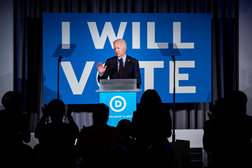
Biden’s remarks, in which he warmly recalled his working relationship in the 1970s with two virulent segregationists, resulted in criticism from presidential rivals. Photo: Audra Melton for The New York Times
Joseph R. Biden Jr. on Wednesday lashed out at his Democratic rivals who had condemned his fond recollections of working relationships with segregationists in the Senate, declining to apologize and defending his record on civil rights….
Senator Kamala Harris of California said the former vice president “doesn’t understand the history of our country and the dark history of our country,” and Senator Cory Booker of New Jersey said Mr. Biden should immediately apologize for using segregationists to make a point about civility in the Senate….
Yet for much of the day, Mr. Biden and his campaign appeared publicly unbowed and intent on defending, or at least explaining, his worldview of politics, which is rooted in his early days in the Senate when, he said, legislators who disagreed still worked together. He cited two defenders of segregation, Senators James O. Eastland of Mississippi and Herman E. Talmadge of Georgia, to make that point.
“Apologize for what?” he said Wednesday evening before appearing at a fund-raiser in Maryland, adding that he “could not have disagreed with Jim Eastland more.”…
There’s not a racist bone in my body. I’ve been involved in civil rights my whole career, period, period, period.”[Said Biden in response to Booker]
At another fund-raiser later that evening, Mr. Biden was sharper in his criticism of the two former Southern senators.
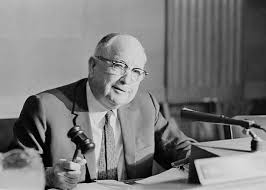
James O. Eastland of Mississippi was one of the senators Mr.Biden recalled working with in the 1970s.Photo: John Rous/Associated Press
“We had to put up with the likes of like Jim Eastland and Hermy Talmadge and all those segregationists and all of that,” he said. “And the fact of the matter is that we were able to do it because we were able to win — we were able to beat them on everything they stood for.”
“We in fact detested what they stood for in terms of segregation and all the rest,” he continued.
Mr. Biden, a longtime supporter of the Voting Rights Act who has cited the civil rights movement as motivation for getting into politics, has many African-American allies, and on Wednesday a number of prominent black leaders defended him, including James E. Clyburn of South Carolina, the House Democratic whip and the highest-ranking African-American in Congress….
The two men developed an “unlikely relationship,” as Mr. Biden put it in his 2007 book, as Mr. Eastland helped Mr. Biden achieve his first seat of power on the Senate Judiciary Committee. Mr. Biden and Mr. Eastland sharply disagreed on several civil rights-related matters, but they were also convenient allies, as both were vocal opponents of school integration through busing, a controversial topic at the time….
Several advisers to Mr. Biden made a concerted public effort to explain and justify his remarks, saying that he was not praising segregationists but rather making a point about working with people with whom one disagrees….
Read full article here
More Breaking News here
Comments Are Welcome
Note: We moderate submissions in order to create a space for meaningful dialogue, a space where museum visitors – adults and youth –– can exchange informed, thoughtful, and relevant comments that add value to our exhibits.
Racial slurs, personal attacks, obscenity, profanity, and SHOUTING do not meet the above standard. Such comments are posted in the exhibit Hateful Speech. Commercial promotions, impersonations, and incoherent comments likewise fail to meet our goals, so will not be posted. Submissions longer than 120 words will be shortened.
See our full Comments Policy here.