New Orleans takes down Confederate monuments under cover of darkness
Share
Explore Our Galleries









Breaking News!
Today's news and culture by Black and other reporters in the Black and mainstream media.
Ways to Support ABHM?
From theguardian.com
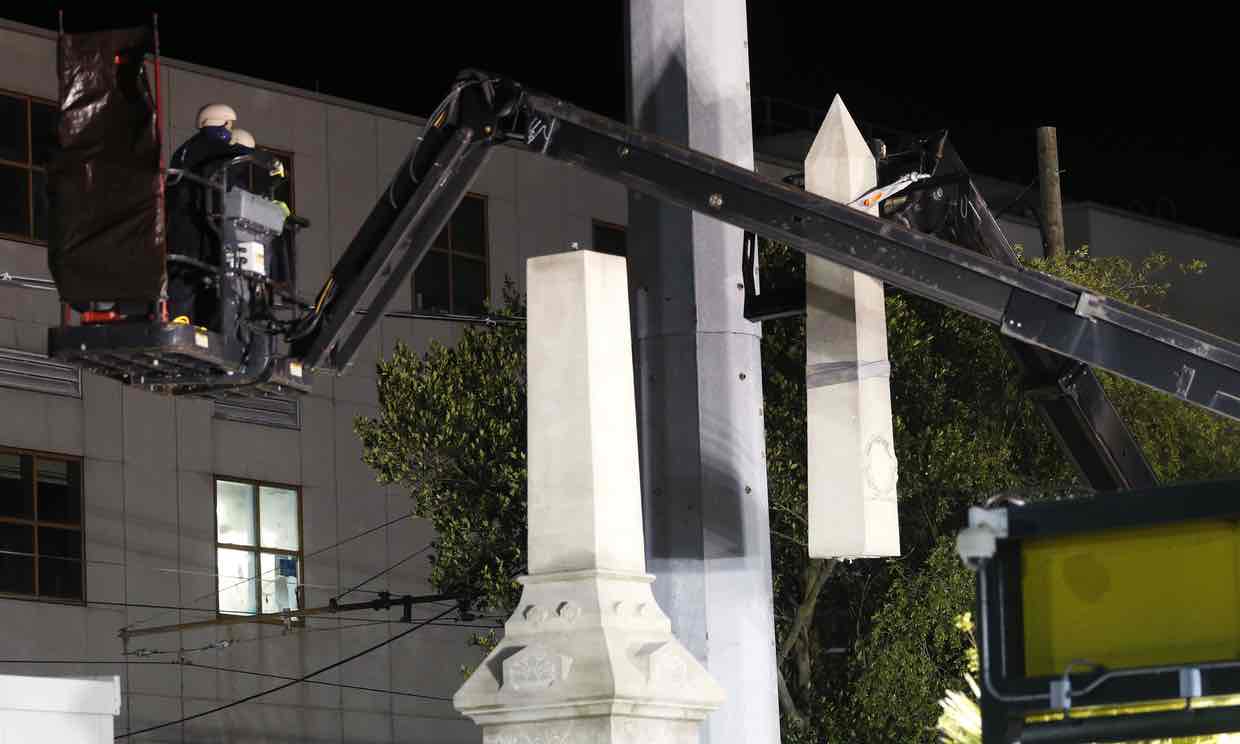
Workers dismantle the Liberty Monument in the early hours of Monday, which commemorates whites who tried to topple a biracial post-civil war government in New Orleans. Photograph: Gerald Herbert/AP
In New Orleans in the small hours of the morning on Monday, workers wearing bulletproof vests and scarves that obscured their faces removed the first of four prominent Confederate monuments.
The precautions were taken in response to what police said were death threats, as the Big Easy became the latest southern institution to sever itself from symbols viewed by many as a representation racism and white supremacy.
The Liberty Monument, which commemorates whites who tried to topple a biracial post-civil war government in New Orleans, was taken away in pieces around 5.35am, after a few hours of work. The removal happened so early in an attempt to avoid disruption from groups who want the monuments to stay. Police were on hand, including officers who watched the area from atop the parking garage of a nearby hotel.
Three other statues, to Confederate generals Robert E Lee and PGT Beauregard and Confederate president Jefferson Davis, will also be removed now legal challenges have been overcome.
“There’s a better way to use the property these monuments are on and a way that better reflects who we are,” New Orleans’s mayor, Mitch Landrieu, said. [Editor’s Note: Mayor Landrieu’s speech about the monuments’ removal, below, is honest, pointed, articulate, touching – and well worth listening to in its entirety.]
Nationally, the debate over Confederate symbols has become heated since nine parishioners were killed at a black church in South Carolina in June 2015, by a gunman who posed online with the Confederate battle flag.
South Carolina removed the Confederate flag from its statehouse grounds in the weeks after the shooting, and several southern cities have since considered removing monuments. The University of Mississippi took down its state flag because it includes the Confederate emblem.
New Orleans is a majority African American city. In 2015 the city council voted 6-1 to approve plans to take the statues down, but legal battles have prevented the removal until now, said Landrieu, who proposed the monuments’ removal and rode to victory twice with overwhelming support from the city’s black residents.
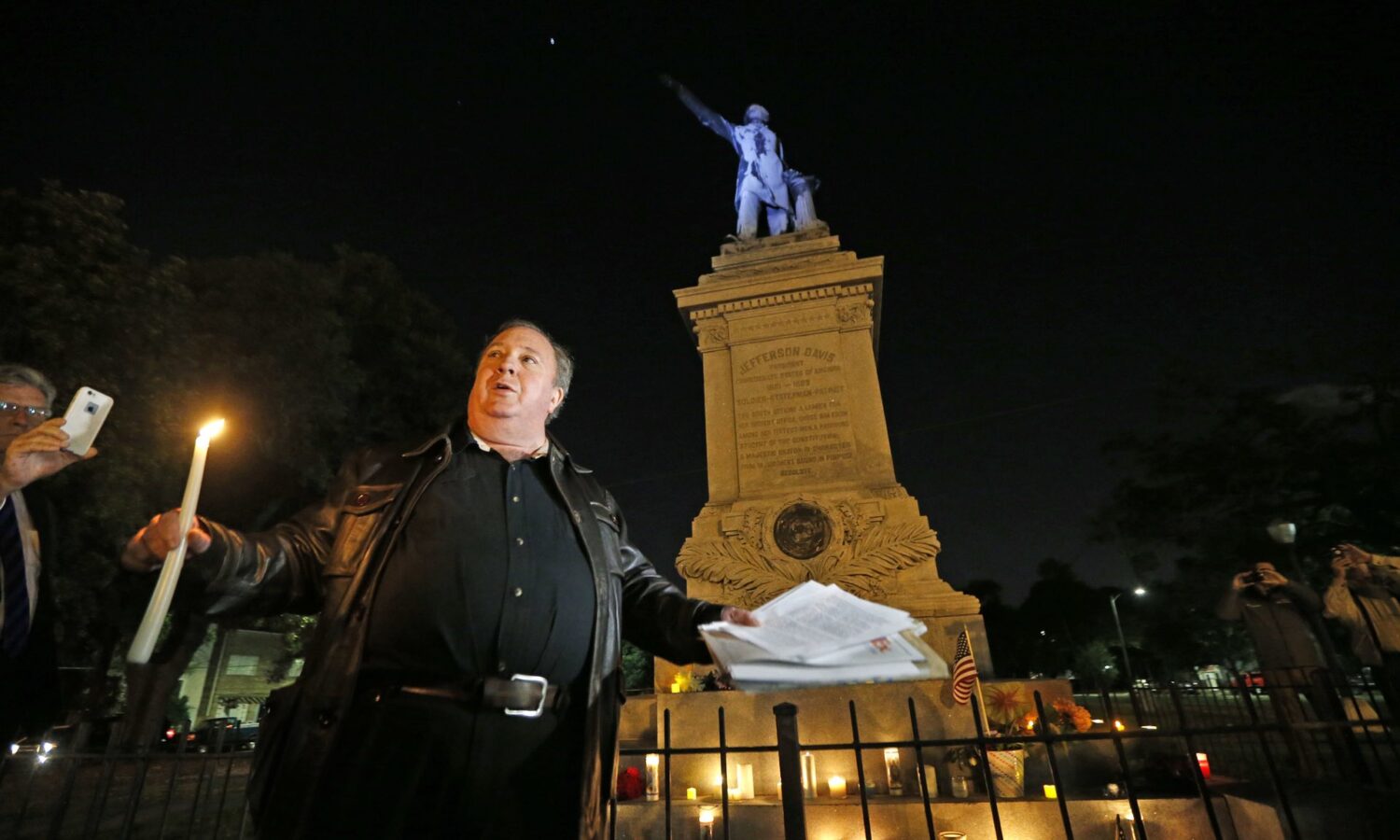
Charles Lincoln speaks during a candlelight vigil at the statue of Jefferson Davis in New Orleans, in protest at the removal of Confederate monuments. Photograph: Gerald Herbert/AP
People who want the Confederate memorials removed say they are offensive artifacts honoring the region’s slave-owning past. Others call the monuments part of the city’s history and say they should be protected historic structures….Landrieu said the memorials did not represent his city as it approaches its 300th anniversary next year. The mayor said the city would remove the monuments, store them and preserve them until an “appropriate” place to display them was determined.
“The monuments are an aberration,” he said. “They’re actually a denial of our history and they were done in a time when people who still controlled the Confederacy were in charge of this city and it only represents a four-year period in our 1,000-year march to where we are today.”
Read the full article here.
More Breaking News here.
Comments Are Welcome
Note: We moderate submissions in order to create a space for meaningful dialogue, a space where museum visitors – adults and youth –– can exchange informed, thoughtful, and relevant comments that add value to our exhibits.
Racial slurs, personal attacks, obscenity, profanity, and SHOUTING do not meet the above standard. Such comments are posted in the exhibit Hateful Speech. Commercial promotions, impersonations, and incoherent comments likewise fail to meet our goals, so will not be posted. Submissions longer than 120 words will be shortened.
See our full Comments Policy here.