76ers’ Doc Rivers merges Black history lessons into camp
Share
Explore Our Galleries









Breaking News!
Today's news and culture by Black and other reporters in the Black and mainstream media.
Ways to Support ABHM?
By Dan Gelston, Associated Press
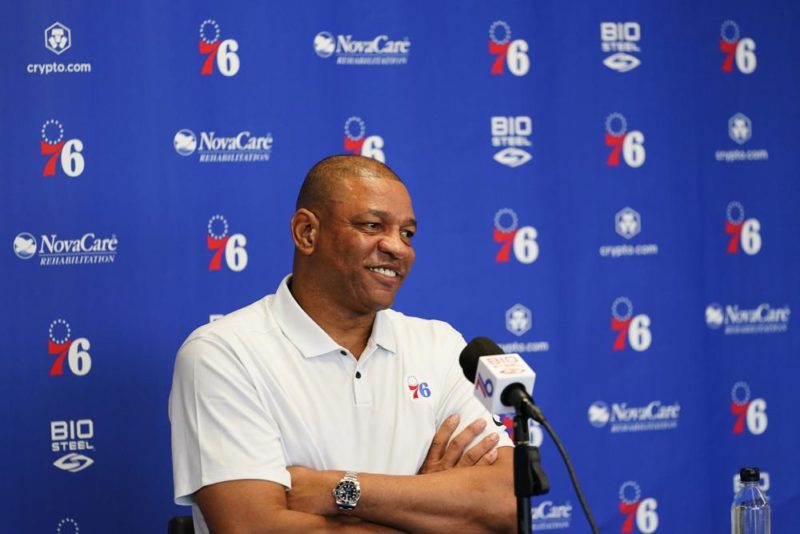
Doc Rivers is at ease using his platform as an NBA coach to fight bigotry and racial injustice, campaign for politicians he believes in and advocate for social change on themes ranging from poverty to police brutality.
Sometimes, his speeches sound like they were delivered by someone running for office. Might the 60-year-old Rivers, the son of a Chicago police officer, someday stump for change as an actual politician?
“Oh God, no. I wouldn’t win, number one,” Rivers said. “And number two, that’s not what I want to be.”
Rivers is fine with wading into political waters — and the older he gets and the more he learns about modern issues and Black history with deep meaning to him, the more he speaks out. At Donald Trump. At police misconduct. At the horrors of racism that have shadowed him his entire life. At the idea that, even as coach of the Philadelphia 76ers, it can still be hard to find his place as a Black man in America.
“When you hear, ‘America first,’ that scares me, because I’m a Black man and that’s not including me,” Rivers said last week in an interview with The Associated Press. “I want us to all be included. I want us all to function with each other.”
Rivers has become an agent of change in the NBA and found his voice as an activist, trying to contribute perhaps more to the league than he has already, first as an All-Star guard and then with a coaching career that includes the 2008 championship with Boston and a spot this year on the list of the 15 Greatest Coaches in NBA History. That outreach starts at home — or perhaps, on this point, on the road — where Rivers used training camp not just as the usual time to rehash X’s and O’s but as a daily history class. The Sixers practiced at The Citadel, the military college where tanks and jets and plaques dedicated to prisoners of wars dot the campus, an education all part of Rivers’ plan to squeeze more out of camp than basketball.
Finish reading at APnews.com
In contrast, some sports coaches don’t understand how race is significant.
ABHM’s breaking news archive includes sports coverage.
Comments Are Welcome
Note: We moderate submissions in order to create a space for meaningful dialogue, a space where museum visitors – adults and youth –– can exchange informed, thoughtful, and relevant comments that add value to our exhibits.
Racial slurs, personal attacks, obscenity, profanity, and SHOUTING do not meet the above standard. Such comments are posted in the exhibit Hateful Speech. Commercial promotions, impersonations, and incoherent comments likewise fail to meet our goals, so will not be posted. Submissions longer than 120 words will be shortened.
See our full Comments Policy here.