1 Year Later: Student’s Vigil Over Ole Miss Noose Goes On
Share
Explore Our Galleries









Breaking News!
Today's news and culture by Black and other reporters in the Black and mainstream media.
Ways to Support ABHM?
By Tyler Carter, theRoot
In 2014, three white students put a noose around the neck of a statue commemorating the first African-American student to attend the University of Mississippi. For almost a year, student Correl Hoyle has maintained a protest in front of the statue.
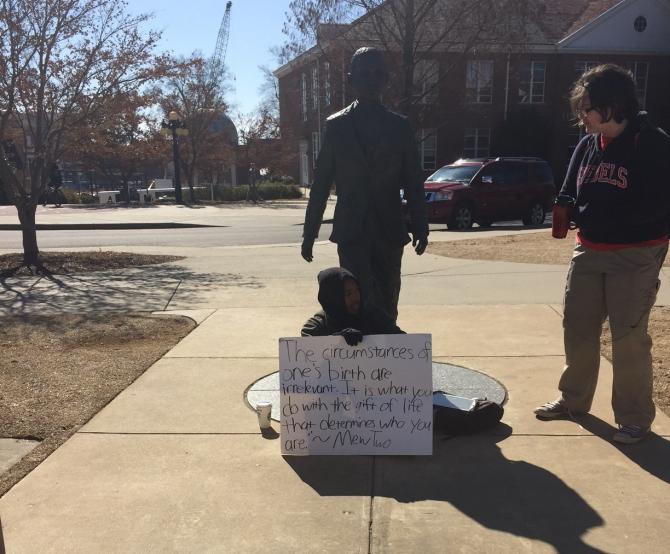
If you walk across the middle of the University of Mississippi’s campus on any given day, you’ll probably see sophomore Correl Hoyle sitting in front of the statue of James Meredith, the first African American to integrate the University of Mississippi, in 1962.
During Valentine’s Day weekend in 2014, three young white men hung a noose around the neck of the statue of Meredith and wrapped a Confederate flag around it. Shortly after, Hoyle, an English major at the university, began holding a vigil in front of the statue.
“A lot of people assumed I was angry after the incident, but I was more so shocked,” Hoyle said. “Never have I experienced something like this at my doorstep, and I was more shocked, but also disappointed because things like this are still happening here. People are still living with the ideology that one race is … superior to the other, or one class of people is better than the other.”
The South, especially Mississippi, has a complex racial narrative, and the University of Mississippi has seen its fair share. In 2012 a white student wrote “N–ger” across a black student’s dorm door. Later that same year a mini-riot erupted on campus after President Obama was re-elected. Just last year, the renaming of Confederate Drive to Chapel Lane spurred a lawsuit against the university by the Mississippi Division Sons of Confederate Veterans, who want to preserve their “history.”
“Simple things like this go unnoticed,” Hoyle said. “If it is not talked about, it will happen again.”
Read the full article here.
Read more Breaking News here.
Comments Are Welcome
Note: We moderate submissions in order to create a space for meaningful dialogue, a space where museum visitors – adults and youth –– can exchange informed, thoughtful, and relevant comments that add value to our exhibits.
Racial slurs, personal attacks, obscenity, profanity, and SHOUTING do not meet the above standard. Such comments are posted in the exhibit Hateful Speech. Commercial promotions, impersonations, and incoherent comments likewise fail to meet our goals, so will not be posted. Submissions longer than 120 words will be shortened.
See our full Comments Policy here.