What Happened to Journalism’s Racial Reckoning?
Share
Explore Our Galleries









Breaking News!
Today's news and culture by Black and other reporters in the Black and mainstream media.
Ways to Support ABHM?
By Anissa Durham, Word in Black
After George Floyd’s murder, white-owned newsrooms promised to support Black journalists. Three years later, how supported are they?
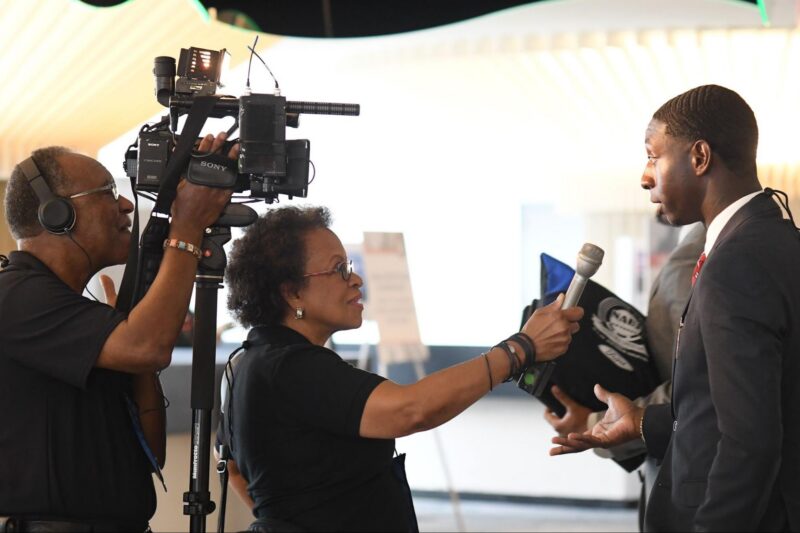
Black journalists are constantly afraid of retaliation.
Three years after George Floyd was murdered, newsrooms pledged to hire more Black staff, address racism in the workplace, and ensure the standard of objectivity wasn’t being used to silence their voices. I wanted to talk to Black reporters about whether what had been promised had come to fruition.
I sent interview requests to about a dozen Black reporters at white-owned outlets asking if they could talk to me about how supported they feel in their newsroom. One reporter after another declined to comment on the record. All of them said they were afraid of retaliation in their newsroom.
[…]
Because so many Black journalists were afraid of going on the record, I got to thinking about what Black-led newsrooms are doing to support each other and their staff. Black news outlets aren’t necessarily Nirvana for Black reporters. There are still times when a Black journalist working for a Black news outlet might be afraid of retaliation for speaking frankly.
However, there is a definite difference in the culture. So, I talked to two journalists that make up the Word In Black collaborative about how they continue to amplify the voices of our community — and support each other.
Without Black Journalists, There Is No News
26-year-old Los Angeles Gabe Schneider works in operations and strategy for L.A. Public Press and is the co-director of The Objective, a nonprofit newsroom examining the power structure and inequity in journalism. During his eight years in the journalism industry, he’s worked in a number of newsrooms where he had to figure out how to exist in those spaces.
When George Floyd was murdered, Schneider worked at MinnPost, a nonprofit, Minneapolis-based digital newsroom where he was the only Black reporter.
“I think there was an acknowledgment that the newsroom needed to be better, but I don’t think it should have taken someone’s death to sort of push that realization to the forefront,” he says. “Reporters … were huge advocates of fixing the newsroom. But they didn’t run the newsroom. There’s always newsroom leadership.”
Like many reporters of color, Schneider was often told by white editors his story ideas were not good enough. And to watch what he posted on social media. If he were to criticize the newsroom he worked in, those in newsroom leadership threatened to fire him.
But one thing is sure — reporters of color have built a community to support one another.
Read the rest of the article here.
Learn about the importance of the Black Press in this ABHvM exhibit.
Find more Breaking News here.
Comments Are Welcome
Note: We moderate submissions in order to create a space for meaningful dialogue, a space where museum visitors – adults and youth –– can exchange informed, thoughtful, and relevant comments that add value to our exhibits.
Racial slurs, personal attacks, obscenity, profanity, and SHOUTING do not meet the above standard. Such comments are posted in the exhibit Hateful Speech. Commercial promotions, impersonations, and incoherent comments likewise fail to meet our goals, so will not be posted. Submissions longer than 120 words will be shortened.
See our full Comments Policy here.