Unraveling the hidden Black history of Appalachian activism
Share
Explore Our Galleries









Breaking News!
Today's news and culture by Black and other reporters in the Black and mainstream media.
Ways to Support ABHM?
By Jessica Wilkerson, Salon
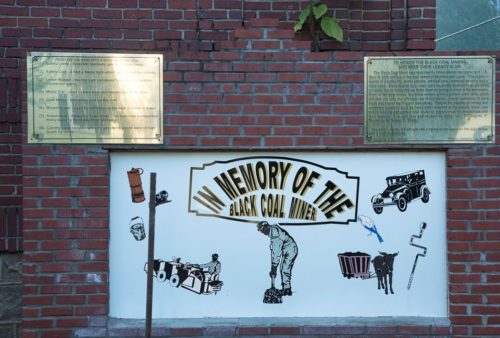
A photograph of a plaque from a Black Appalachia photo series. (Sarah Hoskins)
From the late-nineteenth century to the present, the most popular stories of Appalachia have been simplistic tales of white mountaineers. Those stories have infused everything from culture to politics and media. Despite important counter–examples, these stories continue to be the starting place for most Americans’ understanding of Appalachia — one that erases a complex history of race, racism and Black resistance. Placing Black people in Appalachia’s history is not simply a matter of recognizing diversity. Rather, it forces a different angle, a truer way of seeing the region and its relationship to the South and the United States.
If Black people have been difficult to see in Appalachian history, Black women have been virtually invisible. They can be hard to find in institutional archives that, until the 1970s, did not preserve the history of Black Appalachians with any consistency. And they have been marginalized in a region defined historically by its relationship to whiteness and embodied by white men.
Mary Rice Farris, a Black woman who lived her whole life in Madison County, Kentucky, where the knobby hills meet the bluegrass, worked much of her life to demand that Black Appalachia be seen and heard. Her story, preserved in oral history interviews and other documents at the Berea College Special Collections and Archives, reveals the intersections between African American, Appalachian and women’s history, and how one Black woman from Appalachia fought for Black civil rights and economic justice.
Read the full article here.
Read more Breaking News here.
View more galleries from the ABHM here.
Read more about Sarah Hoskin’s Black Appalachia photo series here.
Comments Are Welcome
Note: We moderate submissions in order to create a space for meaningful dialogue, a space where museum visitors – adults and youth –– can exchange informed, thoughtful, and relevant comments that add value to our exhibits.
Racial slurs, personal attacks, obscenity, profanity, and SHOUTING do not meet the above standard. Such comments are posted in the exhibit Hateful Speech. Commercial promotions, impersonations, and incoherent comments likewise fail to meet our goals, so will not be posted. Submissions longer than 120 words will be shortened.
See our full Comments Policy here.