Unpublished Black History
Share
Explore Our Galleries









Breaking News!
Today's news and culture by Black and other reporters in the Black and mainstream media.
Ways to Support ABHM?
By , and
In July 1967, Newark [New Jersey] erupted with violence after rumors circulated that a black cabdriver had been beaten and killed by white police
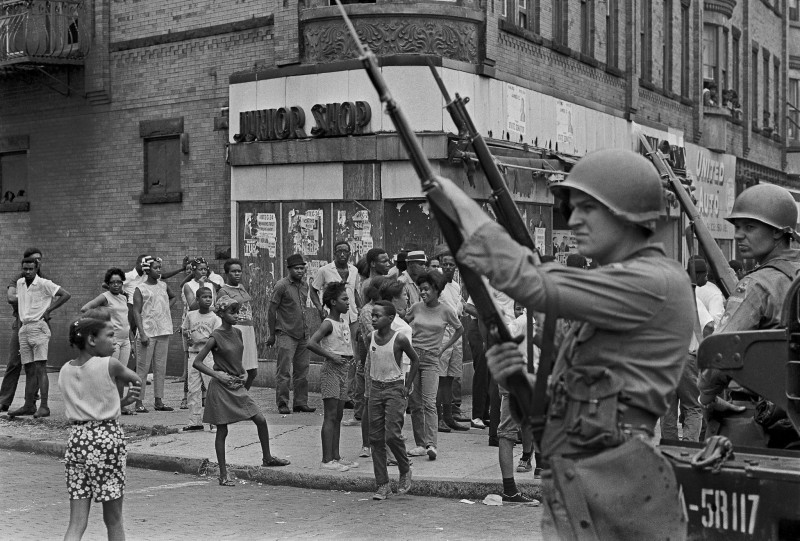
Armed soldiers of the National Guard patrol the streets of Newark, NJ.
officers. He was actually alive — arrested and injured — but for many black residents, it was just another example of Newark’s systemic problems with police abuse, racism, and corruption.
After six days of unrest, 23 people were dead; 725 were injured.
We described the clashes between the National Guard and black residents with the language of war. One of the front-page headlines on July 15 read, “Negroes Battle With Guardsmen.” Another declared, “Sniper Slays Policeman.”
The main photo published that day showed National Guardsmen and police officers standing over black men face down on the ground, with a caption that said the authorities were “searching for weapons and stolen merchandise.”
The photo that was not published, above, shows a calmer scene that points to the wider trauma experienced by Newarkers who were not involved in the violence, but who watched their city burn and their neighbors bleed…
The questions linger. Robert Curvin, the civil rights leader in Newark who later worked for The New York Times and the Ford Foundation,told me in 2006 that he was still haunted by the experience of trying to keep the city calm, to no avail.
“Talking about it is one of the most traumatic and painful things in my life,” said Mr. Curvin, who died last year. “The destruction of human life that I saw in those very short few days, I will never get over.”
Read the full article here.
Read more Breaking News here.
Comments Are Welcome
Note: We moderate submissions in order to create a space for meaningful dialogue, a space where museum visitors – adults and youth –– can exchange informed, thoughtful, and relevant comments that add value to our exhibits.
Racial slurs, personal attacks, obscenity, profanity, and SHOUTING do not meet the above standard. Such comments are posted in the exhibit Hateful Speech. Commercial promotions, impersonations, and incoherent comments likewise fail to meet our goals, so will not be posted. Submissions longer than 120 words will be shortened.
See our full Comments Policy here.