This Day in Black History: The Marine Corps Integrates
Share
Explore Our Galleries









Breaking News!
Today's news and culture by Black and other reporters in the Black and mainstream media.
Ways to Support ABHM?
From the African American Registry
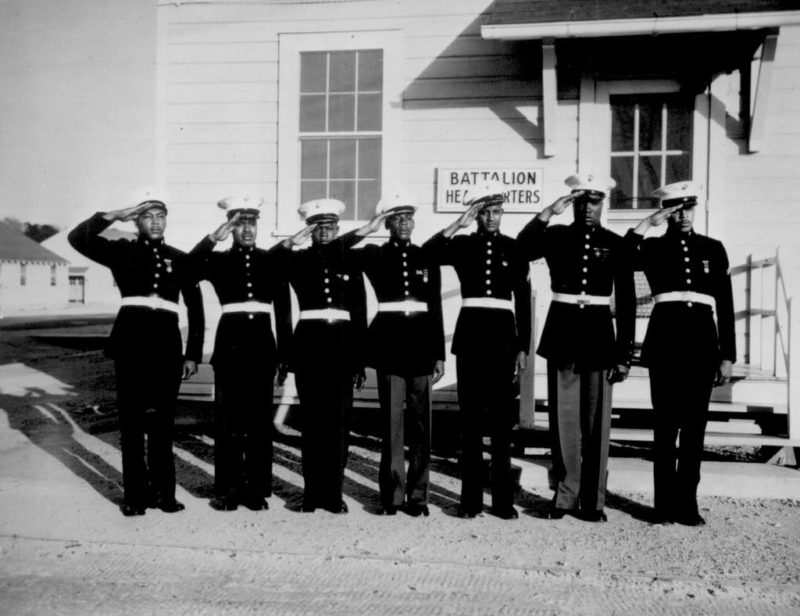
On this date in 1941, the Marine Corps formally integrated. This was a result of President Roosevelt signing Executive Order 8802 months before Pearl Harbor.
FDR officially opened to Blacks one of America’s most celebrated all-white strongholds. In previous years, the Truman order and the Fahy Committee could not budge the services segregation. It was at the urging of his wife, Eleanor, and threatened by civil rights activist A. Philip Randolph with a march on Washington that the Fair Employment Practice Commission was established which prohibited racial discrimination by any government agency.
Black Marines were housed in Montford Point, NC, and recruiting for them had been scheduled for June 1, 1942. A quota of 200 recruits each from Eastern and Central Divisions had been set, while the Southern was to furnish 500 of the initial 900 people. These men were to be enlisted in Class III (c), Marine Corps Reserve, and assigned to inactive duty in a General Service Unit of their Reserve District. Both the service record book and the enlistment contract were to be stamped “COLORED.”
The first African-American recruit to arrive at the camp was Howard P. Perry of Charlotte, NC, on August 26. From July 1942 through the end of the war, 20,000 Black men were trained at Montford Point and inducted into the Marine Corps. Black troops would train and become Marines, they would still be kept separate from the White troops. Unless accompanied by a white Marine, they were not allowed to set foot in Camp Lejeune. And after they were shipped off to battle zones, they served exclusively in all-Black units.
Read more of the story here.
Browse photos of Black veterans.
Comments Are Welcome
Note: We moderate submissions in order to create a space for meaningful dialogue, a space where museum visitors – adults and youth –– can exchange informed, thoughtful, and relevant comments that add value to our exhibits.
Racial slurs, personal attacks, obscenity, profanity, and SHOUTING do not meet the above standard. Such comments are posted in the exhibit Hateful Speech. Commercial promotions, impersonations, and incoherent comments likewise fail to meet our goals, so will not be posted. Submissions longer than 120 words will be shortened.
See our full Comments Policy here.