This Day in Black History: Central State University Founded
Share
Explore Our Galleries









Breaking News!
Today's news and culture by Black and other reporters in the Black and mainstream media.
Ways to Support ABHM?
From the African American Registry
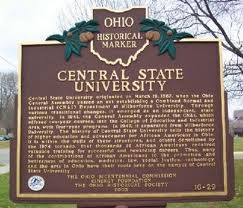
Central State University was founded on this day in 1887 in Ohio. It is one of more than 100 Historically Black Colleges and Universities in America.
CSU’s history begins with its parent institution, Wilberforce University. It was established at Tawawa Springs, Ohio, and affiliated with the African Methodist Episcopal (A.M.E.) Church. It is one of the oldest Black-administered institutions of higher education in the nation.
In 1867, the Ohio General Assembly enacted legislation that created a Combined Normal and Industrial Department at Wilberforce University. The goals of this department were to provide teacher training, vocational education, and program stability with a financial base similar to that of other state-supported institution. The statute establishing the Combined Normal and Industrial Department declared that the institution was “open to all applicants of good and moral character,” thereby having no limitations as to race, color, sex, or creed. It was clear, however, that the design was to serve the educational needs of Black students. Though part of Wilberforce University, a separate board of trustees was appointed to govern the state-financed operations.
In 1941, the department expanded from a two- to a four-year program, and six years later, it legally split from Wilberforce, becoming the College of Education and Industrial Arts at Wilberforce. The name was changed in 1951 to Central State College, and in 1965, the institution achieved university status. Charles H. Wesley, who had been president of Wilberforce before the split in 1947, served as Central State’s first president. His tenure lasted for almost two decades.
Keep up to date with more Black news.
Comments Are Welcome
Note: We moderate submissions in order to create a space for meaningful dialogue, a space where museum visitors – adults and youth –– can exchange informed, thoughtful, and relevant comments that add value to our exhibits.
Racial slurs, personal attacks, obscenity, profanity, and SHOUTING do not meet the above standard. Such comments are posted in the exhibit Hateful Speech. Commercial promotions, impersonations, and incoherent comments likewise fail to meet our goals, so will not be posted. Submissions longer than 120 words will be shortened.
See our full Comments Policy here.