The Legacy of Dr. James Cameron: Founder of America’s Black Holocaust Museum
Share
Explore Our Galleries









Breaking News!
Today's news and culture by Black and other reporters in the Black and mainstream media.
Ways to Support ABHM?
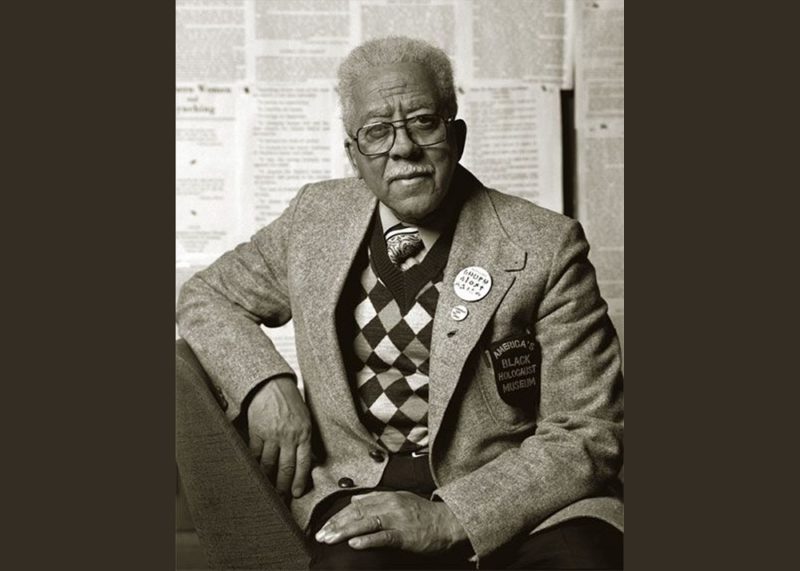
Dr. James Cameron in the first America’s Black Holocaust Museum (Photo courtesy of ABHM)
By Maureen McCollum, wisconsinlife.org
In Milwaukee’s historic Bronzeville neighborhood, a museum is resurrecting.
America’s Black Holocaust Museum was founded in 1988, closed in 2008, and transformed into an online museum. Now, a new physical museum stands, waiting to welcome visitors from around the world. Before understanding the museum’s history and purpose, it helps to get to know its founder, Dr. James Cameron. He’s supposedly the only person in the United States to survive a lynching.
He Heard A Voice
James Cameron was born in La Crosse, Wisconsin on February 25, 1914. La Crosse was a hub for master barbers at the time and his father, who was a barber, moved there to hone his craft. The family eventually left, moved around the country, and settled in Marion, Indiana. It was there that Cameron would experience the most horrific and influential experience of his life.
On August 6, 1930, 19 year-old Abram Smith and 18 year-old Thomas Shipp stopped by Cameron’s house and asked him if he wanted to go for a ride.
“Cameron was 16 at the time,” said America’s Black Holocaust Museum Head Griot Reggie Jackson. “After they got in the car, they told him that they were going to go out to a lover’s lane and rob somebody to get some money to get another car. He reluctantly stayed with them.”
They came across a couple in a car, Claude Deeter and Mary Ball.
“[Abram and Thomas] gave him a gun and Cameron said, ‘I don’t want to have anything to do with this,’” said Jackson. “But peer pressure got the best of him. As soon as he opened the door, he recognized Claude Deeter. It was one of his best friends and a guy that gave him good tips at a shoeshine parlor. So, he gave the gun back to Abe and Tommy and he took off running.”
In the distance, Cameron heard gunshots. Deeter had been killed.
The police soon arrested Smith, Shipp, and Cameron, accusing them of murder…
Read the full article here
More Breaking News here
More ABHM galleries here
Comments Are Welcome
Note: We moderate submissions in order to create a space for meaningful dialogue, a space where museum visitors – adults and youth –– can exchange informed, thoughtful, and relevant comments that add value to our exhibits.
Racial slurs, personal attacks, obscenity, profanity, and SHOUTING do not meet the above standard. Such comments are posted in the exhibit Hateful Speech. Commercial promotions, impersonations, and incoherent comments likewise fail to meet our goals, so will not be posted. Submissions longer than 120 words will be shortened.
See our full Comments Policy here.