Supreme Court Justice Scalia Is Wrong About Affirmative Action
Share
Explore Our Galleries







Breaking News!
Today's news and culture by Black and other reporters in the Black and mainstream media.
Ways to Support ABHM?
By Emily DeRuy, the National Journal
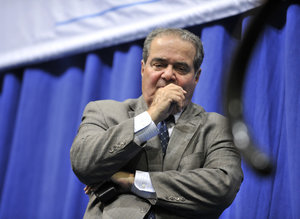
Supreme Court Justice Antonin Scalia’s seeming suggestion last week that students of color would be better off at “a slower-track school where they do well” is not only offensive, it’s wrong.
Black and Latino students who attend selective schools are more likely to graduate than those who attend open-enrollment schools, regardless of how academically prepared they are when they enter.
According to the Georgetown University Center on Education and the Workforce, graduation rates for black and Latino students double when they move to selective schools from open-access colleges.
“Justice Scalia is making the tired argument that admitting African-American students into white schools is akin to putting ponies in a horse race,” said Nicole Smith, the Georgetown Center’s chief economist, in a statement. “Like so many, Justice Scalia mistakes African American as a proxy for low readiness, when in fact minority students in more selective colleges and universities not only graduate at relatively higher rates, but also secure high-paying jobs thereafter.”
Scalia’s comments came as the Supreme Court heard arguments in an affirmative-action case that could have wide-ranging implications. The University of Texas, the defendant in the case, says its use of race has helped ensure diversity. The school also uses a “10 percent plan,” in which any student who graduates in the top 10 percent of a public high school in Texas is granted admission to the University of Texas. Since many of the state’s high schools are largely segregated, the policy increased the number of students of color at the university…
“If Scalia’s theory were true, equally prepared students of all races would do worse at more selective colleges,” said Anthony Carnevale, the Georgetown Center’s director, in a statement. “In fact, we find the opposite is true.”
Affirmative action, the data suggests, not only benefits schools by helping them increase the number of students of color, it offers those students a better chance at a college degree.
Read the full article here.
Read more Breaking News here.
Comments Are Welcome
Note: We moderate submissions in order to create a space for meaningful dialogue, a space where museum visitors – adults and youth –– can exchange informed, thoughtful, and relevant comments that add value to our exhibits.
Racial slurs, personal attacks, obscenity, profanity, and SHOUTING do not meet the above standard. Such comments are posted in the exhibit Hateful Speech. Commercial promotions, impersonations, and incoherent comments likewise fail to meet our goals, so will not be posted. Submissions longer than 120 words will be shortened.
See our full Comments Policy here.