Seay J. (C.J.) Miller
Share
Explore Our Galleries

Newest Exhibit

Breaking News!
Today's news and culture by Black and other reporters in the Black and mainstream media.
Ways to Support ABHM?
Murdered in: Bardell, KY | July 7, 1893
On July 7, 1893, in Bardwell, Kentucky, a crowd of more than 5,000 white individuals lynched Seay J. Miller, a Black man accused of killing two young white girls. Despite clear evidence of his innocence, racial prejudice fueled mob violence that denied him justice. During this period of racial terror in the South, mere allegations of Black involvement in crimes often triggered mob actions and lynchings, circumventing the legal process.
Mr. Miller's innocence was supported by statements from his wife and law enforcement witnesses indicating he was not even present in Kentucky when the girls were murdered. Multiple eyewitnesses identified a white man as the perpetrator, and even the girls' father doubted Mr. Miller's guilt. Nevertheless, under pressure, one witness changed his testimony after being threatened by the sheriff. Rather than protecting Mr. Miller, law enforcement handed him over to the mob, complicit in his brutal lynching.
The mob, determined to inflict maximum suffering, subjected Mr. Miller to horrific torture, including a 100-pound chain around his neck and forced exhaustion. Despite asserting his innocence to the end, Mr. Miller was hanged, shot, mutilated, and burned in a public spectacle that lasted for hours. His lynching was a brutal display of racial terror, intended not just to retaliate for a supposed crime but to intimidate the entire Black community.
The aftermath saw no arrests for the lynching, no investigation of the white suspect in the girls' murders, and continued unjust arrests of local Black residents. Journalist Ida B. Wells documented the atrocity, highlighting the systemic racism that permitted such violence to continue unchecked.
Reflecting on Mr. Miller's unjust death raises lingering questions about America's dedication to justice for all its citizens, especially those who frequently encounter pervasive prejudice rather than protection and opportunities within a just and balanced system.
Believed to be Seay J Miller's final words:
My name is Seay J. Miller, and I am here among you as a stranger and looked on by you the most brutal man that ever stood on God's green earth. I am standing here an innocent man among excited men who propose not to let the law take it's course. I have committed no crime to be deprived of my liberty or life. I am not guilty.
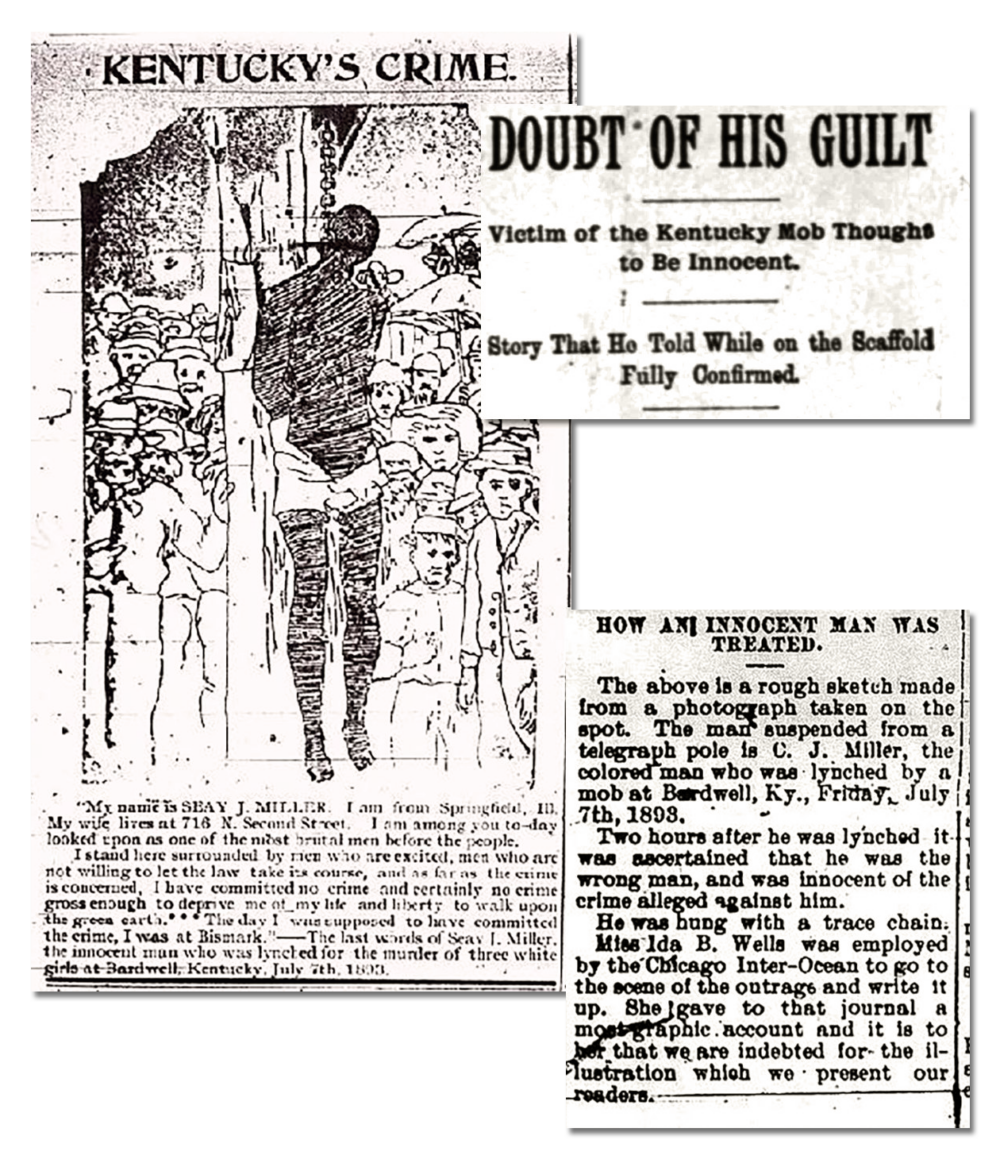
"Kentucky's Crime." News clippings from the Richmond Planet. Aug 26, 1893
Comments Are Welcome
Note: We moderate submissions in order to create a space for meaningful dialogue, a space where museum visitors – adults and youth –– can exchange informed, thoughtful, and relevant comments that add value to our exhibits.
Racial slurs, personal attacks, obscenity, profanity, and SHOUTING do not meet the above standard. Such comments are posted in the exhibit Hateful Speech. Commercial promotions, impersonations, and incoherent comments likewise fail to meet our goals, so will not be posted. Submissions longer than 120 words will be shortened.
See our full Comments Policy here.