Racial Repair and Reconciliation: A Homecoming
Share
Explore Our Galleries









Breaking News!
Today's news and culture by Black and other reporters in the Black and mainstream media.
Ways to Support ABHM?
By Dr. Fran Kaplan, Guest Blogger, Wisconsin Humanities
Note: Staff of the Wisconsin Humanities Council (WHC) asked ABHM’s Virtual Museum Director to blog about her personal reactions to the Gathering for Racial Repair and Reconciliation that honored the museum’s founder, Dr. James Cameron, in February 2014. WHC funded the Gathering.
[…]
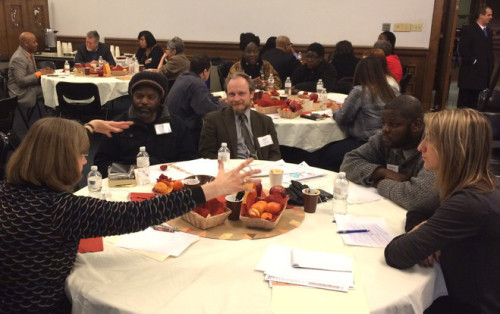
As I looked around the room at the discussions taking place, my heart soared. I experienced a sense of hope for our hyper-segregated city such as I have seldom felt. I was not alone in that feeling. In their evaluations of the event, participants expressed their fervent desire to continue and deepen this dialogue. ABHM is now conducting monthly conversations around the city. This is work that brings me special satisfaction and joy.
In 1971-72 I was a graduate social work student, specializing in community organizing, at the University of Michigan. My field work placement (internship) was with New Detroit, a large, black-led organization that arose to revive the city following the uprisings there. I was assigned to the Speakers Bureau, which conducted anti-racism training and organizing for whites and other non-blacks. As a Jew and a fluent Spanish-speaker, I was asked to reach out to the Jewish and Latino communities.
It was a challenging, uphill struggle, but I loved the work. I had experienced the ways that racism distorts the psyches and lives of both victim and victimizer while growing up Jewish in a small Indiana town, and while living and working in the South with migrant farmworkers. At an early age I had already come to believe that racial/ethnic hatred and power struggles are a principal cause of suffering in the US and around the world – and I determined to do something to change that.
Read the full blog here.
Read more breaking news here.
Comments Are Welcome
Note: We moderate submissions in order to create a space for meaningful dialogue, a space where museum visitors – adults and youth –– can exchange informed, thoughtful, and relevant comments that add value to our exhibits.
Racial slurs, personal attacks, obscenity, profanity, and SHOUTING do not meet the above standard. Such comments are posted in the exhibit Hateful Speech. Commercial promotions, impersonations, and incoherent comments likewise fail to meet our goals, so will not be posted. Submissions longer than 120 words will be shortened.
See our full Comments Policy here.