One of the last surviving Tuskegee Airmen remembers struggle for recognition amid Trump’s DEI purge
Share
Explore Our Galleries









Breaking News!
Today's news and culture by Black and other reporters in the Black and mainstream media.
Ways to Support ABHM?
By MEAD GRUVER and THOMAS PEIPERT, Associated Press
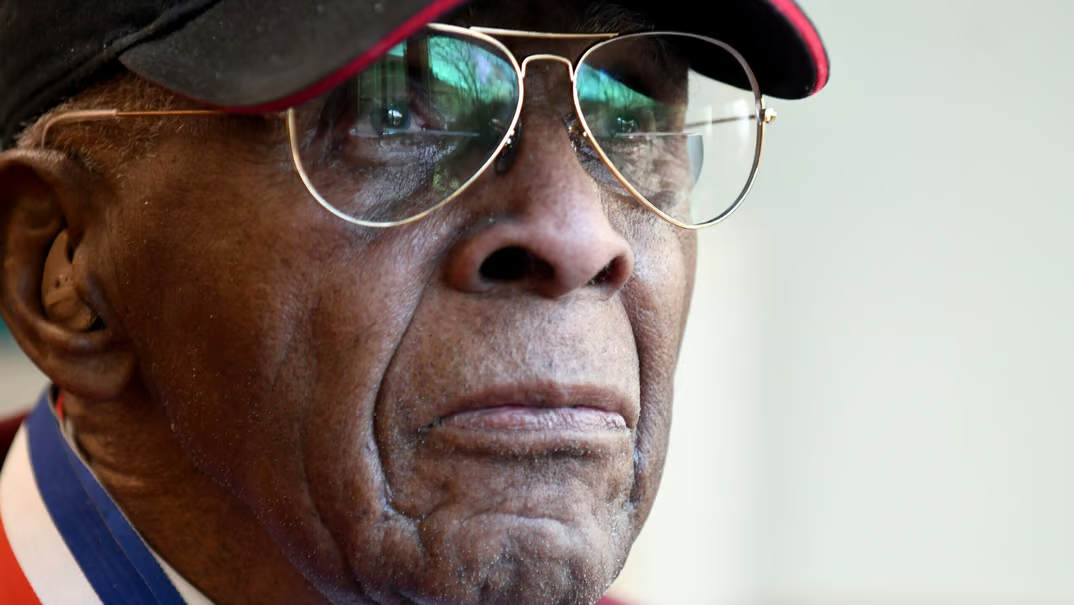
AURORA, Colo. (AP) — With members of a trailblazing Black Air Force unit passing away at advanced ages, efforts to remain true to their memory carry on despite sometimes confusing orders from President Donald Trump as he purges federal diversity, equity and inclusion programs.
Col. James H. Harvey III, 101, is among the last few airmen and support crew who proved that a Black unit — the 332nd Fighter Group of the Tuskegee Airmen — could fight as well as any other in World War II and the years after.
He went on to become the first Black jet fighter pilot in Korean airspace during the Korean War, and a decorated one after 126 missions. He was one of four Tuskegee Airmen who won the first U.S. Air Force Gunnery Meet in 1949, a forerunner of today’s U.S. Navy “Top Gun” school.
“They said we didn’t have any ability to operate aircraft or operate heavy machinery. We were inferior to the white man. We were nothing,” Harvey said. “So we showed them.”
Shortly after Trump’s January inauguration, the Air Force removed new recruit training courses that included videos of the Tuskegee Airmen.
[…]
“I thought there was progress in that area, but evidently there isn’t,” said Harvey, who blamed Trump for contributing to what he sees as worsening prejudice in the U.S.
Read about Harvey’s experience and the current changes.
Discover more Black changemakers and trailblazers in our online exhibits.
Comments Are Welcome
Note: We moderate submissions in order to create a space for meaningful dialogue, a space where museum visitors – adults and youth –– can exchange informed, thoughtful, and relevant comments that add value to our exhibits.
Racial slurs, personal attacks, obscenity, profanity, and SHOUTING do not meet the above standard. Such comments are posted in the exhibit Hateful Speech. Commercial promotions, impersonations, and incoherent comments likewise fail to meet our goals, so will not be posted. Submissions longer than 120 words will be shortened.
See our full Comments Policy here.