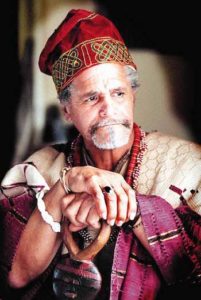
Oba Adefunmi, Spiritual Leader born on this date in 1928
Share
Explore Our Galleries









Breaking News!
Today's news and culture by Black and other reporters in the Black and mainstream media.
Ways to Support ABHM?
By the African American Registry
Oba Efuntola Oseijeman Adelabu Adefunmi,,,was a Black priest (spiritual leader), historian and activist.
Born Walter Eugene King, he was from Detroit, Michigan. King had been baptized into at the age of 12. He left the Baptist faith at age 16 and grew up with an interest in African cultureand began African studies. At the age of 20, King traveled to Haiti in 1954 to study the Haitian culture and Haitian Vodou and, in 1955, to Europe and North Africa, often as a part of the Katherine Dunham Dance Company.
In 1959, just before the Cuban revolution, he traveled to the Matanzas region of Cuba and became the first documented African American to be initiated into the Yoruba priesthood of Obatala, where he was named “Efuntola Oseijeman. Adefunmi”. Efuntola means “the whiteness (of Obatala) is as good as wealth (or honor).” Adefunmi means “the crown has given me this (child).” Upon his return to the United States, he founded the Order of the Damballah Hwedo in Harlem New York, then the Shango Temple, and later incorporated the African Theological Archministry. That organization would come to be called the Yoruba Temple.
Read the full article here.
More Breaking News here
Comments Are Welcome
Note: We moderate submissions in order to create a space for meaningful dialogue, a space where museum visitors – adults and youth –– can exchange informed, thoughtful, and relevant comments that add value to our exhibits.
Racial slurs, personal attacks, obscenity, profanity, and SHOUTING do not meet the above standard. Such comments are posted in the exhibit Hateful Speech. Commercial promotions, impersonations, and incoherent comments likewise fail to meet our goals, so will not be posted. Submissions longer than 120 words will be shortened.
See our full Comments Policy here.