My Great-Grandfather, the Nigerian Slave-Trader
Share
Explore Our Galleries









Breaking News!
Today's news and culture by Black and other reporters in the Black and mainstream media.
Ways to Support ABHM?
By Adaobi Tricia Nwaubani, The New Yorker
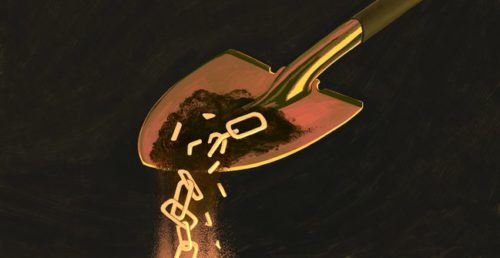
Illustration by Angelica Alzona
My parents’ home, in Umujieze, Nigeria, stands on a hilly plot that has been in our family for more than a hundred years. Traditionally, the Igbo people bury their dead among the living, and the ideal resting place for a man and his wives is on the premises of their home. My grandfather Erasmus, the first black manager of a Bata shoe factory in Aba, is buried under what is now the visitors’ living room. My grandmother Helen, who helped establish a local church, is buried near the study. My umbilical cord is buried on the grounds, as are those of my four siblings. My eldest brother, Nnamdi, was born while my parents were studying in England, in the early nineteen-seventies; my father, Chukwuma, preserved the dried umbilical cord and, eighteen months later, brought it home to bury it by the front gate. Down the hill, near the river, in an area now overrun by bush, is the grave of my most celebrated ancestor: my great-grandfather Nwaubani Ogogo Oriaku. Nwaubani Ogogo was a slave trader who gained power and wealth by selling other Africans across the Atlantic. “He was a renowned trader,” my father told me proudly. “He dealt in palm produce and human beings.”
Long before Europeans arrived, Igbos enslaved other Igbos as punishment for crimes, for the payment of debts, and as prisoners of war. The practice differed from slavery in the Americas: slaves were permitted to move freely in their communities and to own property, but they were also sometimes sacrificed in religious ceremonies or buried alive with their masters to serve them in the next life. When the transatlantic trade began, in the fifteenth century, the demand for slaves spiked. Igbo traders began kidnapping people from distant villages. Sometimes a family would sell off a disgraced relative, a practice that Ijoma Okoro, a professor of Igbo history at the University of Nigeria, Nsukka, likens to the shipping of British convicts to the penal colonies in Australia: “People would say, ‘Let them go. I don’t want to see them again.’ ” Between the fifteenth and nineteenth centuries, nearly one and a half million Igbo slaves were sent across the Middle Passage…
[My family] agreed to hold a deliverance ceremony [to atone for our history of slave trading], and settled on a plan.
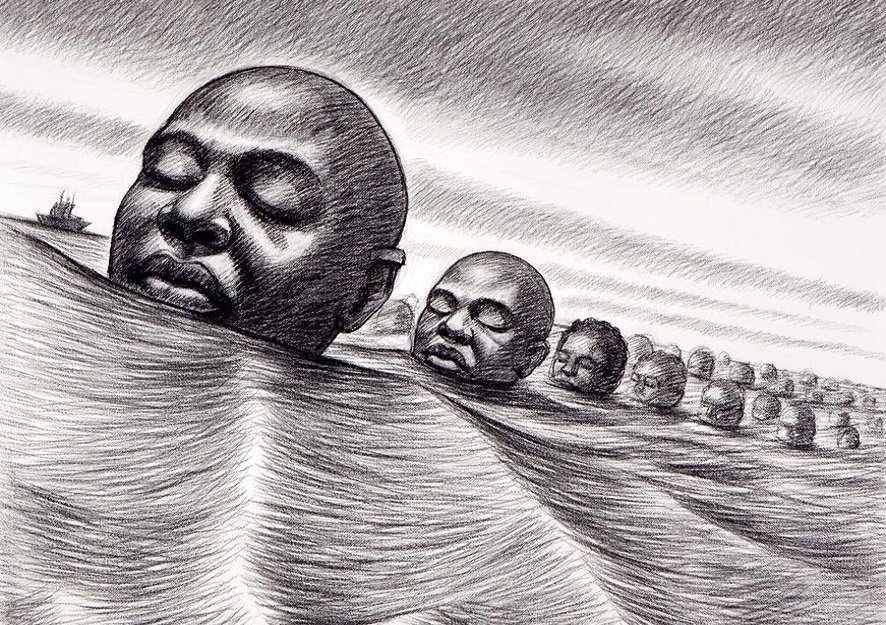
Illustration of the legendary Igbo revolt and mass suicide at Dunbar Landing in 1803. By Jamaican-American artist Donovan Nelson, Ibo Landing 8, Charcoal on paper, 2010
Read entire article here
Read about the Royal Niger Company here
Read about the Igbo Landing here
Read more Breaking News here
Comments Are Welcome
Note: We moderate submissions in order to create a space for meaningful dialogue, a space where museum visitors – adults and youth –– can exchange informed, thoughtful, and relevant comments that add value to our exhibits.
Racial slurs, personal attacks, obscenity, profanity, and SHOUTING do not meet the above standard. Such comments are posted in the exhibit Hateful Speech. Commercial promotions, impersonations, and incoherent comments likewise fail to meet our goals, so will not be posted. Submissions longer than 120 words will be shortened.
See our full Comments Policy here.