Lawsuit seeking reparations for Tulsa Race Massacre is dismissed
Share
Explore Our Galleries









Breaking News!
Today's news and culture by Black and other reporters in the Black and mainstream media.
Ways to Support ABHM?
Dennis Romero, NBC News
An Oklahoma judge cited arguments by defendants, including the city, which said Black survivors of the 1921 riot failed to prove “individualized injury.”
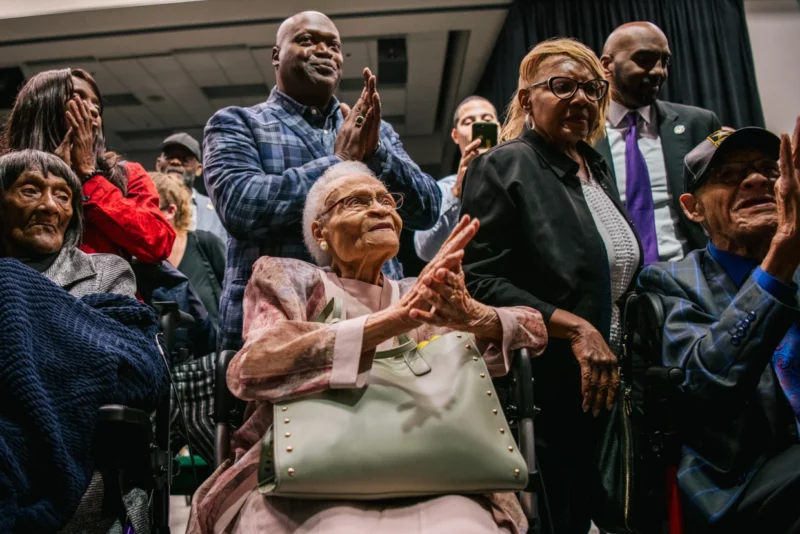
A lawsuit seeking reparations and rebuilding to address historical damage done by the 1921 Tulsa Race Massacre has been dismissed.
The case, filed on behalf of the last three survivors of the assault by a white mob that killed an estimated 300 Black Americans in a community often called “the Black Wall Street” of its day, was dismissed by an Oklahoma judge Friday, according to its record.
Judge Caroline Wall said in her decision that she agreed with defendants, parties that include the state and the city of Tulsa, who moved multiple times to dismiss. Wall dismissed the suit with prejudice, meaning it cannot be refiled in state court.
The plaintiffs, Lessie Benningfield Randle, Viola Fletcher, and Hughes Van Ellis, may still appeal. […]
Among the defendants’ arguments is that the three plaintiffs did not suffer individual, adverse affects from the massacre, which has emerged as an example of government-sanctioned racism and violence that has contributed to uneven outcomes for Black Americans. […]
The lawsuit called it one of the nation’s “worst acts of domestic terrorism.” It argued that plaintiffs like Lessie E. Benningfield Randle, at 108 the oldest survivor of the event, suffered personal losses.
In Randle’s case, her grandmother’s home was looted and destroyed. One of the keys to the discrepancy between white and Black wealth has been intergenerational real estate ownership, with many cases of property destroyed or outright stolen following the Civil War. […]
The defendants maintain that there’s no proof the three plaintiffs suffered “individualized injury.” “Tragically, many people lost their businesses, their homes, and their very lives in the massacre,” they said in a filing in December.
The plaintiffs did not attach a dollar amount to the suit. They have said they want the defendants to rebuild some community elements, such as a hospital, and contribute to a survivors’ fund.
Read more about the lawsuit and the events of the 1921 tragedy in the original article.
Explore this virtual exhibit to learn about the history of lynchings, which took thousands of innocent Black lives like those of the Tulsa Massacre victims.
Find more Breaking News here.
Comments Are Welcome
Note: We moderate submissions in order to create a space for meaningful dialogue, a space where museum visitors – adults and youth –– can exchange informed, thoughtful, and relevant comments that add value to our exhibits.
Racial slurs, personal attacks, obscenity, profanity, and SHOUTING do not meet the above standard. Such comments are posted in the exhibit Hateful Speech. Commercial promotions, impersonations, and incoherent comments likewise fail to meet our goals, so will not be posted. Submissions longer than 120 words will be shortened.
See our full Comments Policy here.