Jury Awards $1million to Oregon woman told ‘I don’t serve Black people’
Share
Explore Our Galleries









Breaking News!
Today's news and culture by Black and other reporters in the Black and mainstream media.
Ways to Support ABHM?
From Associated Press
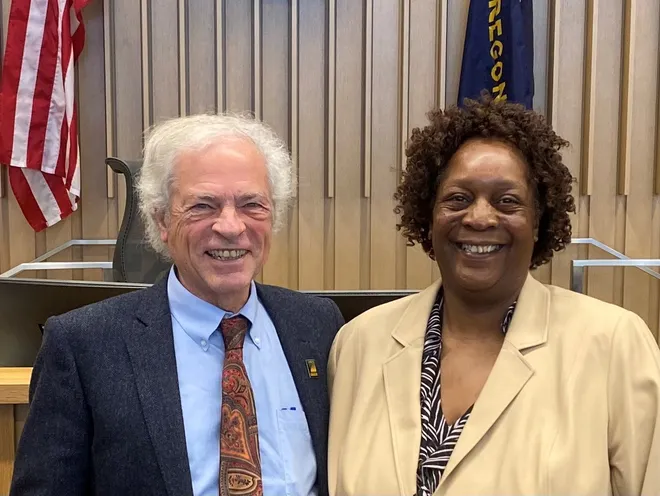
PORTLAND, Ore. (AP) — A jury has awarded an Oregon woman $1 million in damages after finding she was discriminated against by a gas station employee who told her, “I don’t serve Black people.”
The Multnomah County jury’s award this week to Portland resident Rose Wakefield, 63, included punitive damages of $550,000.
Wakefield’s lawyer, Gregory Kafoury, said she stopped for gas at Jacksons Food Store in Beaverton on March 12, 2020, and saw the attendant, Nigel Powers, ignore her and instead pump gas for other drivers.
When she tried to ask for assistance he said, “I’ll get to you when I feel like it,” according to Kafoury.
Attendants are required to pump fuel for motorists at gas stations in Oregon’s larger population centers including Portland and the nearby suburb of Beaverton.
Surveillance video showed Wakefield go inside to ask for help. Another employee followed her back outside to pump her gas. Kafoury said as she was leaving, Wakefield asked Powers why he refused to help her and that he said, “I don’t serve Black people.”
Read more about the incident and ruling.
Despite the successes of the struggle for racial justice, incidents like these continue.
Comments Are Welcome
Note: We moderate submissions in order to create a space for meaningful dialogue, a space where museum visitors – adults and youth –– can exchange informed, thoughtful, and relevant comments that add value to our exhibits.
Racial slurs, personal attacks, obscenity, profanity, and SHOUTING do not meet the above standard. Such comments are posted in the exhibit Hateful Speech. Commercial promotions, impersonations, and incoherent comments likewise fail to meet our goals, so will not be posted. Submissions longer than 120 words will be shortened.
See our full Comments Policy here.