In Ferguson, protesters challenge state of emergency
Share
Explore Our Galleries









Breaking News!
Today's news and culture by Black and other reporters in the Black and mainstream media.
Ways to Support ABHM?
By Abby Phillip, Mark Berman and William Wan, the Washington Post
Police bolstered by emergency orders maintained close watch Tuesday over protest-wracked streets in Ferguson after another night of demonstrations saw multiple arrests and brought new potential flash points.
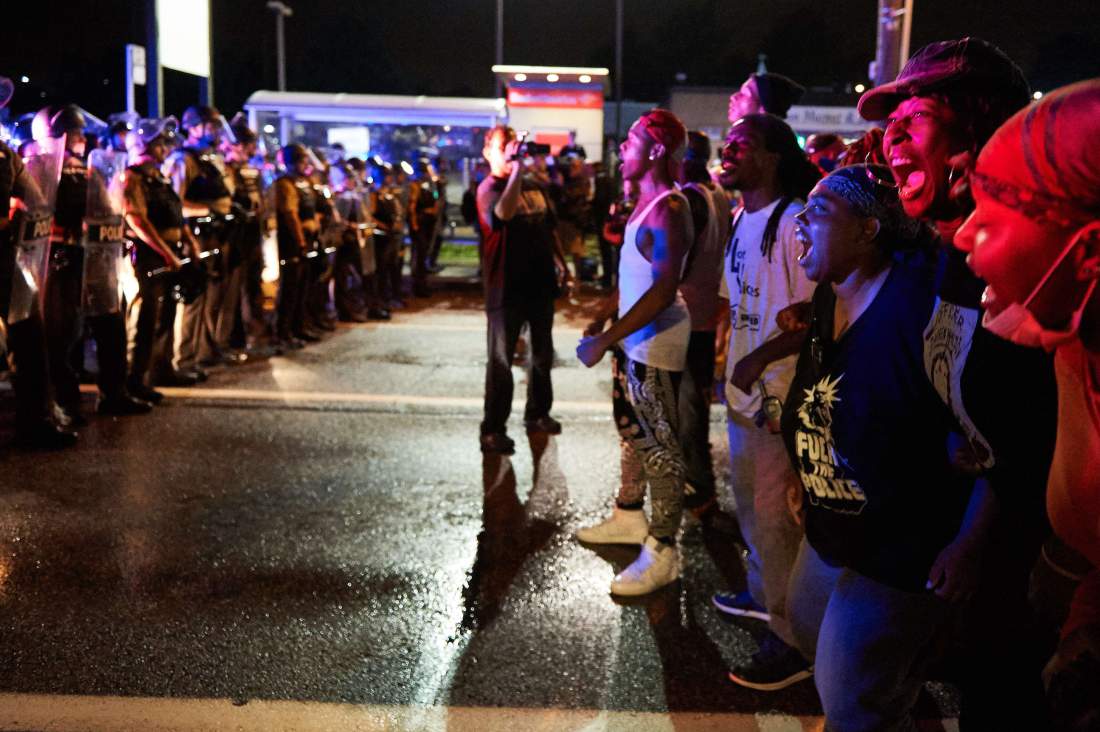
Protesters face police officers on West Florissant Avenue in Ferguson, Missouri on August 9, 2015.
Authorities said Tuesday that there was no repeat of the violence seen a night earlier, when gunshots erupted on the streets of this small suburb of St. Louis…
The latest wave of unrest — set in motion after violence erupted during marches marking the anniversary of the shooting of an unarmed black man — has reopened the deep racial tensions in Ferguson and brought scenes reminiscent of the riots that gripped the St. Louis suburb last year after the death of Michael Brown.
Protesters chanted to the beat of drums in marches along West Florissant Avenue — the epicenter of last year’s clashes — in a show of solidarity that spilled into early Tuesday. Some demonstrators pelted riot police with frozen water bottles and stones.
In a sign that the confrontations could be easing, police on Monday night and early Tuesday morning did not respond with tear gas, and no looting or injuries were reported, said St. Louis County police spokesman Shawn McGuire…
A day earlier, the largely peaceful protests that began Sunday morning with a silent march had been overtaken by nightfall with what appeared to be random violence and opportunistic looting.
An 18-year-old black man shot by police, Tyrone Harris Jr.,… remained in critical condition. Police charged him with 10 counts of assaulting law enforcement, shooting at a motor vehicle and armed criminal action.
The shooting — along with a state of emergency declaration on Monday — served to push tensions higher.
“The recent acts of violence will not be tolerated in a community that has worked so tirelessly over the last year to rebuild and become stronger,” St. Louis County Executive Steve Stenger said in a statement declaring a state of emergency…
Read the full article here.
Read more Breaking News here.
Comments Are Welcome
Note: We moderate submissions in order to create a space for meaningful dialogue, a space where museum visitors – adults and youth –– can exchange informed, thoughtful, and relevant comments that add value to our exhibits.
Racial slurs, personal attacks, obscenity, profanity, and SHOUTING do not meet the above standard. Such comments are posted in the exhibit Hateful Speech. Commercial promotions, impersonations, and incoherent comments likewise fail to meet our goals, so will not be posted. Submissions longer than 120 words will be shortened.
See our full Comments Policy here.