How Rosa Parks’ Legacy Lives On In The Black Lives Matter Movement
Share
Explore Our Galleries









Breaking News!
Today's news and culture by Black and other reporters in the Black and mainstream media.
Ways to Support ABHM?
Rosa Parks would believe that #BlackLivesMatter, too.
By Zeba Blay, t
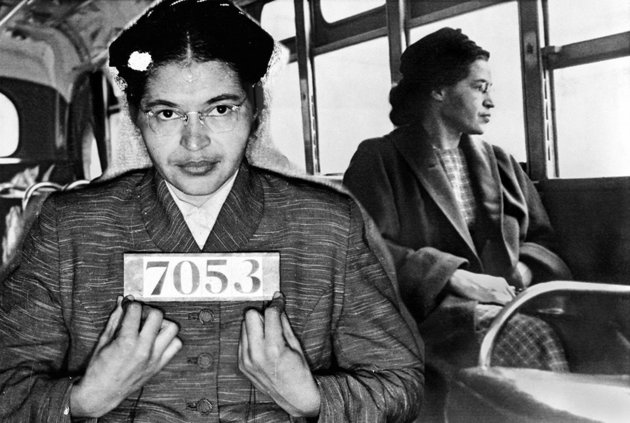
Photo credit: Getty Images/Huffpost
Sixty years ago on this day, Rosa Parks refused to give up her seat on a Montgomery, Alabama bus and settled in to American history. We’ve seen the iconic pictures of Parks getting booked at the police station, or later staged seated on a bus looking pensively out the window. Parks has become one of the great, mythic figures of the Civil Rights era — a kind of sanctified figure who feels worlds away from the current, volatile era of social justice. But she isn’t.
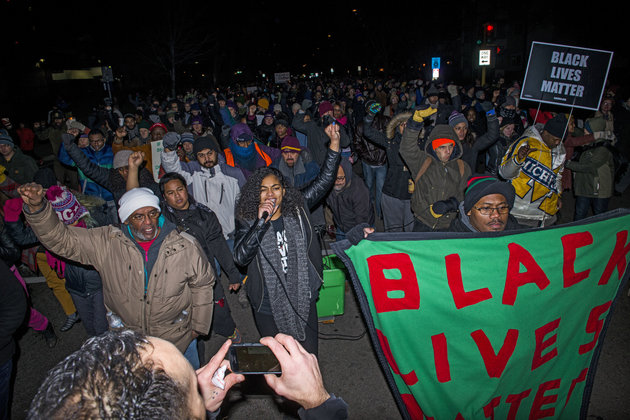
Today’s fight for civil rights and social justice may…seem like the very antithesis of the movement in which Parks played an integral part. In many ways, this is true. The intersection of technology, social media, and grassroots activism has produced a very different kind of struggle. The #BlackLivesMatter movement…has been criticized for being divisive (“All lives matter!“), disruptive, aimless, and even violent, in the wake of heated protests in Ferguson and…Chicago.
#BlackLivesMatter protestors are considered a stark contrast to the apparent respectability of the civil rights activists of the 1960s. When we think of those protesters, we think of peaceful black people marching quietly…turning the other cheek and nobly rising above the abuse of water-hose wielding police officers and tear gas.
People believe #BlackLivesMatter…will fail to replicate the successes of the Civil Rights era because its overriding message is one of frustration, not “peace and love.” But this perception of the 1960s Civil Rights era as “respectable” and #BlackLivesMatter as disruptive is far too simplistic, disregarding the nuances of both movements…
In elementary school classrooms Parks has been introduced as the meek Christian woman who refused to give her bus seat up for a white rider simply because she was tired. In actuality, Parks made a calculated act of defiance, orchestrated by the Montgomery chapter of the NAACP of which she was an active and passionate member, designed to be the catalyst for what would become the Civil Rights Movement.
(Photo Credit: Stephen Maturen)
It’s important to remember that part of why Parks was chosen to spark the bus boycott was a question of respectability — she was a seamstress and a secretary, “Somebody [we] could win with,” as chapter president E.D. Nixon explained later..
And yet, “respectability” was not the beginning and end of who Parks was. Parks was not passive, she was not meek… The incident marked the second time she had been kicked off the bus, by the same driver, in a time when these kinds of public protests were…incredibly dangerous. Parks was defiant, she was inconvenient, she was disruptive. So often, disruptiveness and defiance are mistaken for a kind of violence. Do we expect that Parks quiet, polite, “respectable,” when she refused to give up her seat, knowing that she would be arrested and harassed?
Criticisms of the #BlackLivesMatter movement consistently pit it against the Civil Rights Movement. “What would Martin Luther King think,” detractors ask. “What would Rosa Parks think?” Rosa Parks would believe that black lives matter, because Rosa Parks, alongside King and the NAACP, formed the catalyst for the #BlackLivesMatter movement.
The iconic photos of Parks in our history books are only a fraction of who she really was, and what she truly represented. Into the ’70s, ’80s, and ’90s, Parks remained a passionate activist, speaking out against housing discrimination, police brutality, and our broken prison system.
In her private writings…she wrote about the frustration, dismay, and anger she felt about racism and segregation. “There is just so much hurt, disappointment and oppression one can take,” she once wrote. “The line between reason and madness grows thinner.” Her justifiable anger and defiance is what links today’s civil rights activist to Parks and her contemporaries. In that sense, the #BlackLivesMatter movement is not a disruption but a continuation of the work that Parks and others began.
Read the full article here.
Read more Breaking News here.
Comments Are Welcome
Note: We moderate submissions in order to create a space for meaningful dialogue, a space where museum visitors – adults and youth –– can exchange informed, thoughtful, and relevant comments that add value to our exhibits.
Racial slurs, personal attacks, obscenity, profanity, and SHOUTING do not meet the above standard. Such comments are posted in the exhibit Hateful Speech. Commercial promotions, impersonations, and incoherent comments likewise fail to meet our goals, so will not be posted. Submissions longer than 120 words will be shortened.
See our full Comments Policy here.