House passes historic anti-lynching bill after Congress’s century of failure
Share
Explore Our Galleries









Breaking News!
Today's news and culture by Black and other reporters in the Black and mainstream media.
Ways to Support ABHM?
By Felicia Sonmez, Washington Post
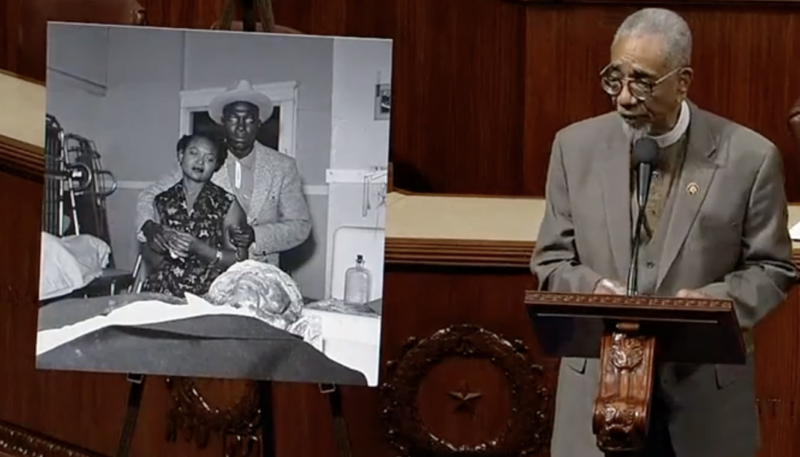
Rep. Bobby Rush stands on the U.S. House floor next to a photograph of Mamie Till and her future husband, Gene Mobley, as she views her son Emmett Till’s body. (Image is a still from C-SPAN video.)
House Speaker Nancy Pelosi (D-Calif.) also took to the floor to salute Rush for spearheading the bill and to urge members to support it.
“We cannot deny that racism, bigotry and hate still exist in America,” she said, citing the 2017 white nationalist rally in Charlottesville, among other recent incidents.
The measure’s passage comes after lawmakers tried, and failed, to pass anti-lynching bills nearly 200 times.
The earliest such attempt came in 1900, when Rep. George Henry White (R-N.C.), then the country’s only black member of Congress, stood on the floor of the House and read the text of his unprecedented measure, which would have prosecuted lynchings at the federal level. The bill later died in committee.
Years later, Rep. Leonidas C. Dyer (R-Mo.) introduced an anti-lynching measure that passed the House but was filibustered in the Senate by Southern Democrats, many of whom opposed it in the name of “states’ rights.”
In 2005, the Senate approved a resolution apologizing for its failure to enact anti-lynching legislation. Then-senator Mary Landrieu (D-La.) pointed to the horrific impact of the chamber’s decades of inaction, declaring that “there may be no other injustice in American history for which the Senate so uniquely bears responsibility.”
At least 4,742 people, mostly African Americans, were reported lynched in the United States from 1882 to 1968 in all but four states, the text of Rush’s legislation notes. Ninety-nine percent of perpetrators escaped state or local punishment, it adds.
See ABHM galleries here.
Comments Are Welcome
Note: We moderate submissions in order to create a space for meaningful dialogue, a space where museum visitors – adults and youth –– can exchange informed, thoughtful, and relevant comments that add value to our exhibits.
Racial slurs, personal attacks, obscenity, profanity, and SHOUTING do not meet the above standard. Such comments are posted in the exhibit Hateful Speech. Commercial promotions, impersonations, and incoherent comments likewise fail to meet our goals, so will not be posted. Submissions longer than 120 words will be shortened.
See our full Comments Policy here.
My oh My!!
I just stumbled across your website! I’m pleasantly surprised! Expect a visit from us soon!!
Please know that your mission is much needed and extremely appreciated. Thank you for what you are doing!!
Be the Blessing!