Here’s Why You Need To Know About The 1917 Silent Parade
Share
Explore Our Galleries









Breaking News!
Today's news and culture by Black and other reporters in the Black and mainstream media.
Ways to Support ABHM?
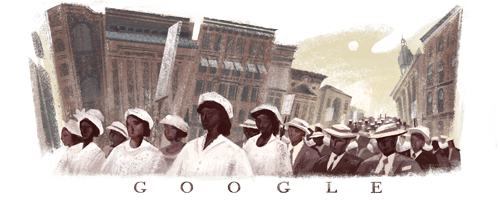
Via Google
The anti-lynching protest became known as the first mass demonstration by African Americans….
Google commemorated the 100th anniversary of the anti-lynching Silent Parade with a doodle on its homepage Friday….
Women and children marched in the front, wearing white to represent innocence in the midst of the country’s racism, according to the Miami Herald. The men marched in the back, dressed in dark suits as a symbol of mourning and their willpower to fight for their rights.
Protesters demanded President Woodrow Wilson take action to protect the rights and livelihood of African Americans. They carried signs reading “Thou Shalt Not Kill,” “Your Hands Are Full of Blood” and “Mothers, do lynchers go to heaven?”…
Just a few weeks prior to the march, racial tensions grew thick among the black and white workers in East St. Louis, Illinois. For 24 hours, white mobs burned homes and killed any black person they could find, regardless of age, gender or ability.
https://youtu.be/jph3BYrdHgs
The mob killed about 200 people while the remaining 6,000 black residents fled their homes to escape the violence, according to Yale’s Beinecke Library.
The Silent Parade became known as the first mass demonstration by African Americans. The New York Times described it as “one of the most quiet and orderly demonstrations ever witnessed,” per the Herald. The silence was only broken when the march ended. Even without chants or songs, the Silent Parade set the tone for how black people protest today.
Read the full article here.
Read more Breaking News here.
Comments Are Welcome
Note: We moderate submissions in order to create a space for meaningful dialogue, a space where museum visitors – adults and youth –– can exchange informed, thoughtful, and relevant comments that add value to our exhibits.
Racial slurs, personal attacks, obscenity, profanity, and SHOUTING do not meet the above standard. Such comments are posted in the exhibit Hateful Speech. Commercial promotions, impersonations, and incoherent comments likewise fail to meet our goals, so will not be posted. Submissions longer than 120 words will be shortened.
See our full Comments Policy here.