Confederate past: Uproar over changing park names
Share
Explore Our Galleries









Breaking News!
Today's news and culture by Black and other reporters in the Black and mainstream media.
Ways to Support ABHM?
by Adrian Sainz, Associated Press, theGrio.com
MEMPHIS, Tenn. (AP) — The statue of Confederate fighter Nathan Bedford Forrest astride a horse towers above the Memphis park bearing his name.
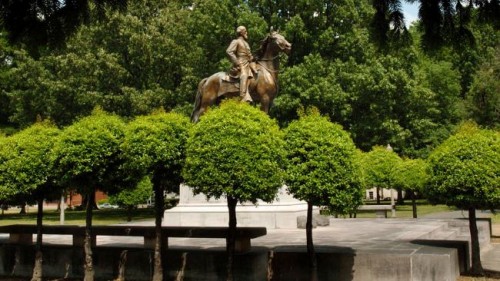
A statue of Confederate Gen. Nathan Bedford Forrest stands in Nathan Bedford Forrest Park in Memphis, Tenn. Nearly 150 years after the Civil War ended, Forrest continues to spark new political battles and racial discord in Memphis.
It’s a larger-than-life tribute to the warrior still admired by many for fiercely defending the South in the Civil War — and scorned by others for a slave-trading past and ties to the Ku Klux Klan.
Though the bloodiest war on American soil was fought 150 years ago, racially tinged discord flared before its City Council voted this week to strip Forrest’s name from the downtown park and call it Health Sciences Park. It also voted to rename Confederate Park as Memphis Park and Jefferson Davis Park as Mississippi River Park….
The changes have drawn praise from those who said bygone reminders of the Confederacy had to be swept away in what today is a racially diverse city. Critics cried foul, saying moves to blot out such associations were tantamount to rewriting the history of a Mississippi River city steeped in Old South heritage.
The struggle over Forrest’s legacy and moves to rename other parks highlights a broader national debate over what Confederate figures represent in the 21st century as a far more diverse nation takes new stock of the war on its 150th anniversary with the hindsight of the civil rights era….
Kennith Van Buren, a local African-American civil rights activist, said stripping away park names tied to the Confederacy or its leading figures were overdue.
“It’s very offensive,” he said. “How can we have unity in the nation when we have one city, right here in Memphis, which fails to be unified?”
Most of the emotion over the council’s action has centered on Forrest. His defenders, mostly white, cite Forrest’s accomplishments as an alderman, businessman and military leader. Critics, black and white, say honoring Forrest glorifies a slave trader and Ku Klux Klan member.
Read more about Forrest and the controversy here.
Read more Breaking News here.
Comments Are Welcome
Note: We moderate submissions in order to create a space for meaningful dialogue, a space where museum visitors – adults and youth –– can exchange informed, thoughtful, and relevant comments that add value to our exhibits.
Racial slurs, personal attacks, obscenity, profanity, and SHOUTING do not meet the above standard. Such comments are posted in the exhibit Hateful Speech. Commercial promotions, impersonations, and incoherent comments likewise fail to meet our goals, so will not be posted. Submissions longer than 120 words will be shortened.
See our full Comments Policy here.