Black in America: It’s not just about the color of your skin
Share
Explore Our Galleries









Breaking News!
Today's news and culture by Black and other reporters in the Black and mainstream media.
Ways to Support ABHM?
By Moni Basu, CNN
Editor’s Note: In today’s United States, is being black determined by the color of your skin, by your family, by what society says or something else? Soledad O’Brien reports “Who Is Black in America?” on CNN at 8 p.m. ET/PT Sunday, December 15.
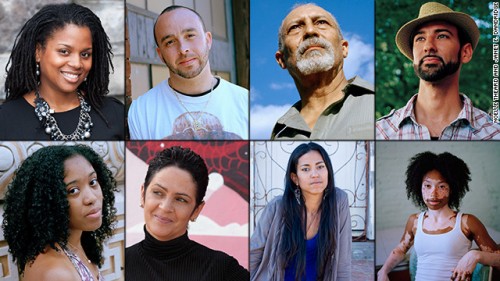
What is black? Race. Culture. Consciousness. History. Heritage.
A shade darker than brown? The opposite of white?
Who is black? In America, being black has meant having African ancestry.
But not everyone fits neatly into a prototypical model of “blackness.”
Scholar Yaba Blay explores the nuances of racial identity and the influences of skin color in a project called (1)ne Drop, named after a rule in the United States that once mandated that any person with “one drop of Negro blood” was black. Based on assumptions of white purity, it reflects a history of slavery and Jim Crow segregation.
In its colloquial definition, the rule meant that a person with a black relative from five generations ago was also considered black.
One drop was codified in the 1920 Census and became pervasive as courts ruled on it as a principle of law. It was not deemed unconstitutional until 1967.
Blay, a dark-skinned daughter of Ghanian immigrants, had always been able to clearly communicate her racial identity. But she was intrigued by those whose identity was not always apparent. Her project focuses on a diverse group of people – many of whom are mixed race – who claim blackness as their identity.
That identity is expanding in America every day. Blay’s intent was to spark dialogue and see the idea of being black through a whole new lens.
Read more here.
We post more identity articles in breaking news.
Comments Are Welcome
Note: We moderate submissions in order to create a space for meaningful dialogue, a space where museum visitors – adults and youth –– can exchange informed, thoughtful, and relevant comments that add value to our exhibits.
Racial slurs, personal attacks, obscenity, profanity, and SHOUTING do not meet the above standard. Such comments are posted in the exhibit Hateful Speech. Commercial promotions, impersonations, and incoherent comments likewise fail to meet our goals, so will not be posted. Submissions longer than 120 words will be shortened.
See our full Comments Policy here.