Biden signs police reform executive order on George Floyd anniversary
Share
Explore Our Galleries









Breaking News!
Today's news and culture by Black and other reporters in the Black and mainstream media.
Ways to Support ABHM?
By Lauren Gambino, The Guardian
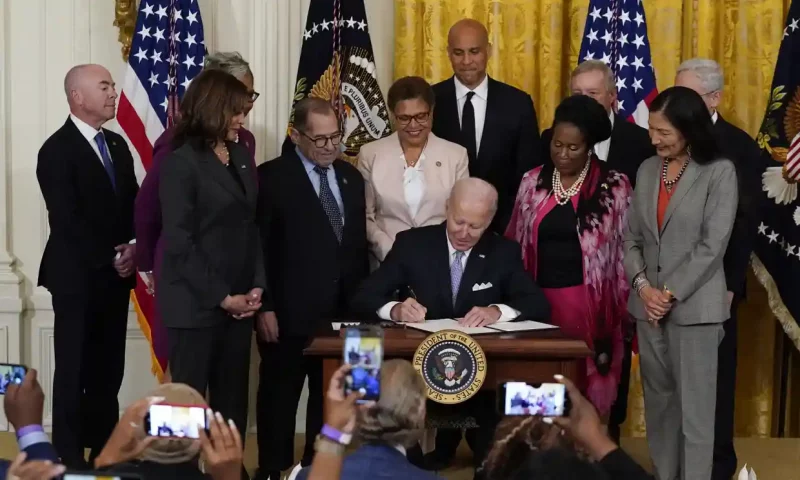
President to take action regulating federal law enforcement agencies after failure of attempts to legislate
Joe Biden signed an executive order he promised would usher in the “most significant police reform in decades” on Wednesday, the second anniversary of the murder of George Floyd.
With Congress deadlocked, Biden said he was using the powers of the presidency to advance his campaign promises and deliver police accountability and reform “that is real and lasting.”
Biden was joined at the White House for a signing ceremony by Floyd’s family as well as relatives of Breonna Taylor, who was killed when police executed a no-knock warrant at her apartment in 2020. In remarks preceding the signing, Biden praised them for their efforts to push for change even as they grieve.
“It’s not about their death but what we do in their memory that matters,” he said.
The executive order signed on Wednesday directs federal agencies to revise use-of-force policies, banning tactics such as chokeholds, restricting practices like no-knock warrants and promoting de-escalation techniques.
Find out more about this executive order.
George Floyd’s family met with President Biden last year. Discover what else happened in the first year after Floyd’s murder.
If you’re interested in civil rights, our breaking news section has you covered.
Comments Are Welcome
Note: We moderate submissions in order to create a space for meaningful dialogue, a space where museum visitors – adults and youth –– can exchange informed, thoughtful, and relevant comments that add value to our exhibits.
Racial slurs, personal attacks, obscenity, profanity, and SHOUTING do not meet the above standard. Such comments are posted in the exhibit Hateful Speech. Commercial promotions, impersonations, and incoherent comments likewise fail to meet our goals, so will not be posted. Submissions longer than 120 words will be shortened.
See our full Comments Policy here.