‘Beautiful pots enhance humanity’: Magdalene Odundo on her quest to make the perfect pot
Share
Explore Our Galleries









Breaking News!
Today's news and culture by Black and other reporters in the Black and mainstream media.
Ways to Support ABHM?
By Emine Saner, The Guardian
Her vessels are often inspired by people’s gestures in the supermarket – and have sold for six-figure sums. She talks about childhood bereavement, why she hated making ads – and the spiritual significance of cooking pots.
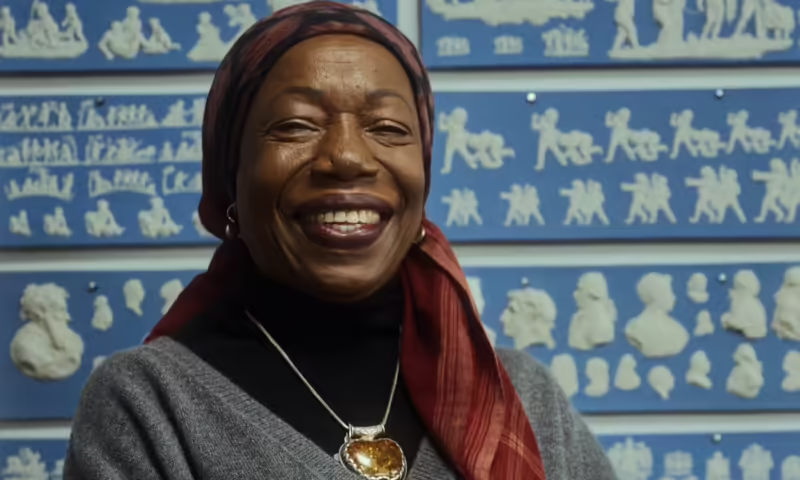
Stare at one of Magdalene Odundo’s vessels for long enough and you start to wonder if you might just have seen it breathe, its rounded belly imperceptibly expanding. The ceramic artist has often talked about the “body-ness”, as she puts it, of her pots, but standing close to one is to be struck by how alive they feel. Her current London show at Thomas Dane Gallery, comprising six vessels, is Odundo’s first solo exhibition in the capital for 20 years. It’s a continuation of her show earlier this year at Houghton Hall, the stately home in Norfolk. Odundo has found new recognition in recent years – a significant 2019 Hepworth Wakefield exhibition, and she showed at this year’s Venice Biennale. Her work set a new record price for a living ceramicist when one of her vessels sold for £200,000 in 2020, the same year she was made a dame.
[…]
Odundo’s work is physical, lifting and manipulating the clay. “It is the contact with the material, the dialogue you have while you’re making – it’s very difficult to replace,” she says. “I can indulge in thinking, I can sketch, sit out and enjoy the shapes in the sky and the forms of trees and things like that. But until I transfer that energy into my material, I just feel lost.” Still, she adds, one doctor said that her desperation to get back to work will probably help her recovery. Maybe it will change her work, I say. “You mean start trampling on it and making ‘art’?” She laughs. “That’s going to be interesting. I have tried it before, it didn’t work with me.” Of course not – Odundo’s work is too exquisite for such silliness.
At Houghton Hall, where she was both the first Black artist and the first woman to have an exhibition, her vessels held their own in an English stately home, surrounded by ancestral images of powerful white men. One piece came out of Odundo’s residency at Wedgwood – a towering sculpture featuring imagery of enslaved people, as well as contemporary protests in Kenya, inspired by the link between founder Josiah Wedgwood and anti-slavery campaigner Olaudah Equiano. “I’ve always wanted to do semi-political or a kind of civic, social piece of work,” says Odundo.
At her London show, her vessels look both organic and otherworldly. Never have I wanted to touch an exhibition piece more. Does the feel of the pieces change according to where they are? “I think to a certain extent, the spirit …” She pauses. “I want to say dynamics, or the essence, and the body language – my work is very bodily orientated – changes a bit.” In museums, “you’re coming across other associations and so there’s a comparative nature to settings like that.” In a solo show, “the work has to have meaning, has to transmit, translate and narrate on its own. It’s like a dancer being left on stage to do their solo, and they’re pirouetting.”
Odundo, 74, has been revered for many years – she has influenced many younger artists, including Theaster Gates, and fashion designers such as Loewe’s Jonathan Anderson – but she is now getting more mainstream recognition. How does that feel? “It’s difficult to say, because I’ve always worked very quietly and sort of singly.” She has never shared a studio, she points out. Showing in the mid-1980s gave her the confidence, she says, to focus on the work, and not who might want to buy it. “Of course, I wanted the work to be bought, I wanted great collectors and great museums to have it. But I think if I had concentrated on that, I would be making perhaps what Michael Cardew [the eminent potter, who was one of Odundo’s teachers] used to call things other people want and not what you have trained for. I’ve taken the fact that I’ve been able to live off my work for all these years as an endorsement of my convictions, and a testament of staying true to who you are.”
Odundo was born in Kenya, but spent part of her childhood in Delhi, where her father was a journalist. Later, back in Kenya, still then under British rule, “the schools were very oriented to apartheid and for most Africans, there wasn’t an opportunity to be in well-endowed schools. We were taught needlework because it was thought that we’d end up being housemaids. So it was a very unequal education.”
Check out another Black artist you should know: Carrie Mae Weems.
Read more Breaking News.
Comments Are Welcome
Note: We moderate submissions in order to create a space for meaningful dialogue, a space where museum visitors – adults and youth –– can exchange informed, thoughtful, and relevant comments that add value to our exhibits.
Racial slurs, personal attacks, obscenity, profanity, and SHOUTING do not meet the above standard. Such comments are posted in the exhibit Hateful Speech. Commercial promotions, impersonations, and incoherent comments likewise fail to meet our goals, so will not be posted. Submissions longer than 120 words will be shortened.
See our full Comments Policy here.