A Jewish philanthropist funded this pioneering school for Black students. Now it’s getting a second life.
Share
Explore Our Galleries









Breaking News!
Today's news and culture by Black and other reporters in the Black and mainstream media.
Ways to Support ABHM?
Hannah Feuer, Forward
As a campaign for a national park honoring Julius Rosenwald awaits action in Congress, residents of rural Kentucky have already begun preserving his legacy
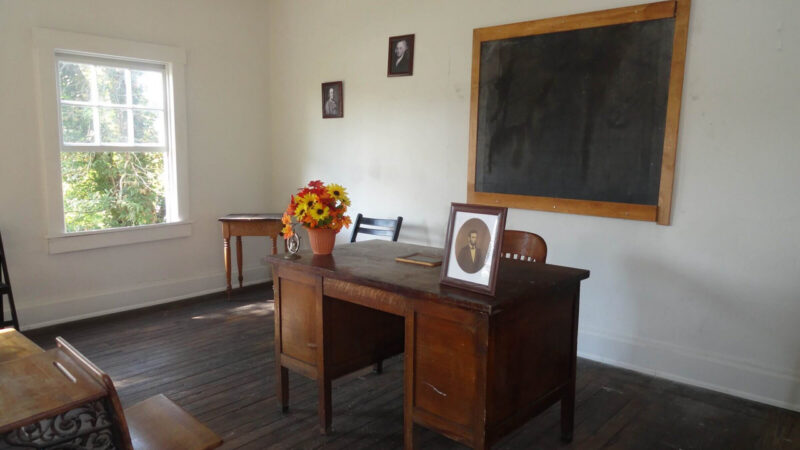
A small Kentucky town has saved a piece of Black history, with a little-known Jewish connection.
This summer, Sadieville, Kentucky — population 320 — opened an exhibit in a one-room schoolhouse that served Black students during segregation.
Built between 1917 and 1920, the school was partly funded by Jewish philanthropist Julius Rosenwald, an owner of Sears, Roebuck and Company who gave much of his fortune away as part of a collaboration with the influential Black educator Booker T. Washington.
The Sadieville school was one of 5,000 schools for Black students across 15 states that Rosenwald helped fund. The schools transformed Black education across the rural South during the Jim-Crow era, dramatically improving students’ literacy rates and economic mobility.
But today, many of the schoolhouses are in danger of abandonment. As preservationists seek federal recognition of Rosenwald schools in Congress through a proposed national park, the residents of Sadieville took matters into their own hands.
“It is one of our little special treasures that we have here, because there are so few of them remaining in the United States,” Laura Centers, Sadieville’s city clerk, told the Forward. “We want to protect our history.”
Recently introduced legislation in both the House and Senate would help protect that history nationally, but both bills have languished in committee. To pass, they will need Republican support — at a time when the National Park Service is already dealing with staffing shortages and a slim budget. So far, Rep. Rob Wittman of Virginia is the only Republican to sign on.
Sadieville would not be included in the proposed national park, which would initially cover three schools in Maryland, South Carolina and Virginia, along with a headquarters in Chicago. But Dorothy Canter, a retired biophysicist who leads the Rosenwald national park campaign, said local preservation efforts are still essential to the broader movement.
“It helps the campaign because it’s a part of history,” Canter said. “It’s part of Sadieville history.”
Comments Are Welcome
Note: We moderate submissions in order to create a space for meaningful dialogue, a space where museum visitors – adults and youth –– can exchange informed, thoughtful, and relevant comments that add value to our exhibits.
Racial slurs, personal attacks, obscenity, profanity, and SHOUTING do not meet the above standard. Such comments are posted in the exhibit Hateful Speech. Commercial promotions, impersonations, and incoherent comments likewise fail to meet our goals, so will not be posted. Submissions longer than 120 words will be shortened.
See our full Comments Policy here.