Tour highlights race-based poverty and inequity across Mississippi Delta region
Share
Explore Our Galleries









Breaking News!
Today's news and culture by Black and other reporters in the Black and mainstream media.
Ways to Support ABHM?
By Dwayne Fatherree, SPLC
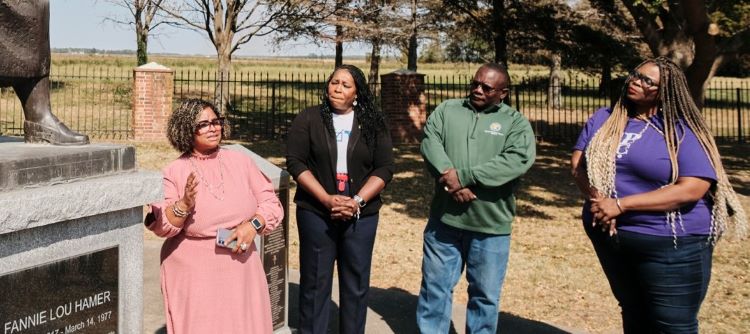
Interstate highways have dramatically compressed parts of the United States. But when you get off the big federal roadways, the ground unfurls for miles in every direction.
Nowhere is that truer than driving into the Mississippi Delta. The green mile markers and clip-clop of expansion joints give way to huge expanses of farmland, the occasional remains of a barn or rusting farm equipment and, very rarely, the blinking yellow light marking another roadway cutting across the expanse.
It was the heart of the nation’s cotton production before the U.S. Civil War. But the change in Mississippi’s constitution in 1890 to allow Black farmers’ fields to be taken away and the mechanization of agriculture combined to drive Black migration northward. What had been one of the few areas in the South where it was not unusual to see Black legislators and local political office holders slid fully under the shadow of Jim Crow.
Overcoming more than a century of abuse and neglect was part of the purpose behind the inaugural Truth, Poverty and Democracy Tour. The effort, a collaboration between the Southern Poverty Law Center’s Mississippi state office, the Foundation for the Mid South, Mississippi Legislative Black Caucus, NAACP Legal Defense Fund, ACLU-MS, Mississippi Poor People’s Campaign and others, combined a multicity bus tour through the region with a series of community conversations, talks and roundtables at which Mississippians were able to directly share their struggles with advocacy and civic groups and state leaders.
Discussions centered on the lived experiences of people in the poorest regions, offering the chance to discuss strategies and policies that can provide pathways out of poverty against the backdrop of the Delta’s ongoing struggle for survival.
“We’re here in the Mississippi Delta, so this really illuminates what lies at the intersection of race, poverty and democracy here in the state of Mississippi,” said Waikinya Clanton, director of the SPLC’s Mississippi state office. “I know generally when people think about democracy, they don’t generally think about the connections between that and poverty eradication and what it really looks like.”
SPLC explains how Clanton discussed everything from truth to poverty to democracy.
Discover some of the Black history that contributes to current inequality.
Keep up to date with current Black news here.
Comments Are Welcome
Note: We moderate submissions in order to create a space for meaningful dialogue, a space where museum visitors – adults and youth –– can exchange informed, thoughtful, and relevant comments that add value to our exhibits.
Racial slurs, personal attacks, obscenity, profanity, and SHOUTING do not meet the above standard. Such comments are posted in the exhibit Hateful Speech. Commercial promotions, impersonations, and incoherent comments likewise fail to meet our goals, so will not be posted. Submissions longer than 120 words will be shortened.
See our full Comments Policy here.